

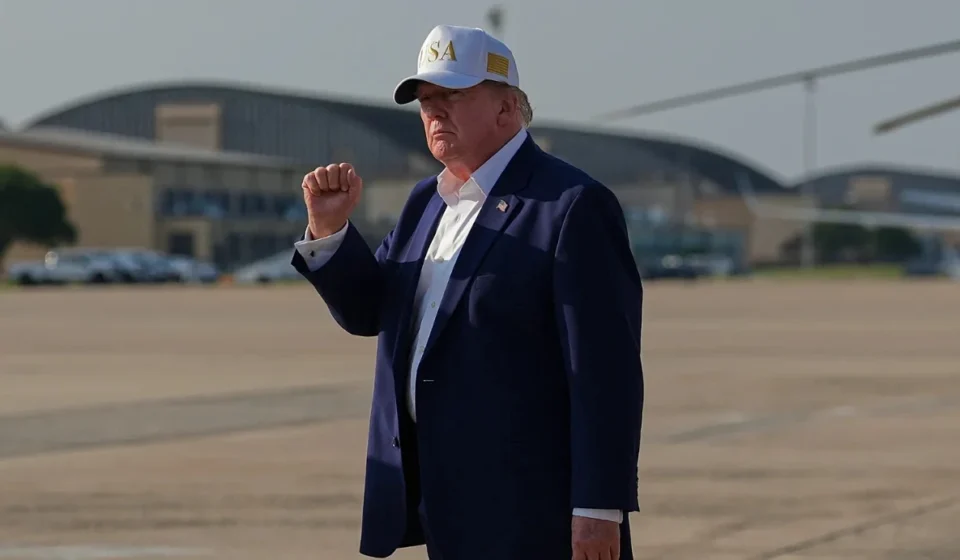

President Donald Trump has demanded financial compensation from Iran as negotiators work toward a possible end to the conflict, adding a major economic dispute to already difficult peace talks. At the same time, Trump confirmed that U.S. Navy forces are carrying out minesweeping operations in the Strait of Hormuz, a strategically vital waterway whose security has become central to the negotiations.
The combination of financial demands and military activity highlights how far the two sides remain from a straightforward settlement. While diplomats search for a path toward de escalation, ships, sailors, oil markets and millions of people who depend on stable energy supplies remain caught in the consequences of the confrontation.
Trump Puts Compensation at the Center of the Dispute
Trump’s demand for compensation represents a hardening of the financial terms Washington wants from Tehran. Rather than treating the peace process solely as a discussion about ending military operations, the president is seeking payment for losses that the United States attributes to Iran and its actions during years of regional conflict.
The demand comes as Iran has also raised its own claims for compensation. Tehran has argued that the United States should bear responsibility for damage caused during the conflict and has linked any broader settlement to the lifting of sanctions, the easing of military pressure and changes to the situation surrounding the Strait of Hormuz.
That creates a difficult negotiating structure. Both governments are approaching the talks with demands that could be interpreted domestically as a measure of victory. For American officials, accepting Iranian compensation demands could appear to concede responsibility for military actions. For Iranian leaders, agreeing to pay Washington could carry an equally heavy political cost at home.
We should therefore view the compensation dispute as more than a question of money. It is also a contest over responsibility, sovereignty and the political narrative that will shape how each government explains any eventual agreement to its own population.
Why the Strait of Hormuz Matters So Much
The Strait of Hormuz is one of the world’s most consequential maritime chokepoints. The narrow passage connects the Persian Gulf with the Gulf of Oman and the wider Arabian Sea. Large volumes of crude oil and petroleum products normally move through the waterway, making any prolonged disruption a concern far beyond the Middle East.
For families, businesses and transport companies, the issue can eventually reach far beyond the battlefield. Higher shipping costs can affect fuel prices, while uncertainty over energy supplies can increase expenses for manufacturers, airlines and logistics companies. Governments also face pressure when sudden energy increases begin filtering into household budgets.
The U.S. Navy has extensive experience with mine countermeasures in the region. Its official Navy resources describe mine countermeasures as a vital part of keeping maritime routes open and protecting commercial movement through strategically important waters.
That history gives the current operation particular significance. Mines are difficult to detect and can threaten commercial vessels even after active fighting has declined. Clearing them is therefore not simply a military task. It is a prerequisite for restoring confidence among shipping companies and insurers that vessels can safely pass through the waterway.
U.S. Minesweeping Signals a Long Road Back to Normal Shipping
Trump’s confirmation of minesweeping operations sends a message that Washington is preparing for the practical challenges of reopening the waterway. Even if negotiators reach a political understanding, commercial shipping cannot immediately return to normal if mines or other maritime hazards remain.
Mine clearance requires specialized ships, aircraft, underwater equipment and highly trained personnel. The work can be slow because crews must identify possible threats before deciding how to neutralize them. A single suspected mine can force vessels to alter course or temporarily suspend movement through an area.
The U.S. Navy has previously conducted mine countermeasure operations with international partners in the Arabian Gulf. Those operations have focused on detecting, identifying and clearing underwater threats while maintaining secure maritime routes. The strategic importance of this mission is reflected in the Navy’s description of the Strait of Hormuz as one of several critical maritime chokepoints in the region.
The immediate challenge is therefore both diplomatic and physical. Negotiators need to establish conditions for a political settlement, while naval personnel need to make the surrounding waters safe enough for commercial traffic to resume.
Peace Talks Face a Difficult Bargaining Environment
Compensation is only one part of a much larger negotiation. The United States has pushed for changes involving Iran’s military capabilities, nuclear activities and regional conduct, while Iran has demanded an end to military pressure and relief from economic restrictions.
The Strait of Hormuz adds another layer of urgency. Tehran has used the waterway as a central bargaining issue, while Washington has insisted that commercial navigation must be restored. Each side can therefore view control over the passage as both an economic necessity and a source of negotiating leverage.
That makes the diplomatic atmosphere unusually fragile. A statement that appears minor in Washington can carry major political consequences in Tehran, and the reverse is also true. Leaders must demonstrate strength to domestic audiences while leaving enough room for negotiators to reach a compromise.
The main issues facing negotiators include:
- Financial compensation and competing claims for wartime losses
- The reopening and long term security of the Strait of Hormuz
- Restrictions and guarantees concerning Iran’s nuclear activities
- Sanctions and access to frozen Iranian financial assets
- Future military activity by the United States and Iran
- Security arrangements intended to prevent another escalation
Oil Markets Are Watching Every Development
Financial markets have reacted quickly to changes in expectations surrounding the negotiations. Oil prices rose sharply as hopes for an immediate agreement weakened, reflecting fears that restrictions around the Strait of Hormuz could last longer than previously expected.
Reuters reported on August 11 that Brent crude was trading near $88 a barrel after a sharp rise the previous day, while U.S. West Texas Intermediate remained above $82. The market reaction illustrates how closely energy traders are following the diplomatic process.
For consumers, the consequences may not appear immediately at the gasoline pump. Oil moves through a complex chain involving shipping, refining, storage and distribution. But sustained disruption can eventually increase costs across the energy system, particularly if insurers and shipping companies begin pricing greater risks into their operations.
The situation is especially sensitive for countries that depend heavily on imported energy. Governments across Asia, Europe and the Middle East must weigh the possibility of prolonged disruption against their available inventories and alternative supply routes.
Iran’s Response Could Determine the Next Phase
Iran now faces a difficult choice. Rejecting Trump’s compensation demand could preserve Tehran’s negotiating position but make a broader agreement harder to achieve. Accepting some form of financial settlement could help unlock negotiations over other issues, but it could also provoke criticism from Iranian political factions that oppose concessions to Washington.
The same political pressure exists on the American side. Trump has presented the conflict in terms of American security and national interests. Any agreement that requires the United States to make significant concessions could therefore become a domestic political test, particularly if the administration portrays compensation as an essential part of the settlement.
For ordinary people on both sides, however, the calculation is much simpler. Families want security, predictable prices and an end to the fear that another round of military action could begin. Businesses want reliable trade routes. Seafarers want safe passage. Energy producers and consumers want stability.
What Happens Next
The coming days could determine whether the compensation dispute becomes a negotiating tool or a barrier to an agreement. If diplomats can separate the question of financial claims from immediate steps to secure the Strait of Hormuz, there may be room for incremental progress.
A practical sequence could involve continued mine clearance, monitored maritime access, temporary military restraint and negotiations over longer term security arrangements. Such measures would not resolve every dispute, but they could reduce the immediate risks facing commercial shipping and create breathing room for diplomacy.
Any durable agreement will also need credible mechanisms for verifying commitments. Without clear verification, either side could accuse the other of violating the settlement, potentially reopening the cycle of retaliation.
A Critical Test for Diplomacy
Trump’s demand for compensation has introduced another contentious issue into already difficult peace talks, while the confirmation of U.S. Navy minesweeping operations demonstrates that the military consequences of the conflict remain active even as diplomats negotiate.
The Strait of Hormuz now sits at the intersection of military security, global energy markets and international diplomacy. Clearing the waterway may make physical passage safer, but reopening it fully will require political agreement as well.
For the negotiations to succeed, both governments will eventually have to move beyond competing claims about who should pay and who should accept responsibility. The larger test will be whether Washington and Tehran can establish enough trust, security and practical guarantees to prevent another confrontation from closing one of the world’s most important maritime routes.
For now, the message from Washington is unmistakably firm: the United States wants compensation, continued pressure on Tehran and secure passage through Hormuz. The response from Iran, and whether negotiators can reconcile those positions, may determine whether the current conflict moves toward a settlement or another dangerous escalation.