
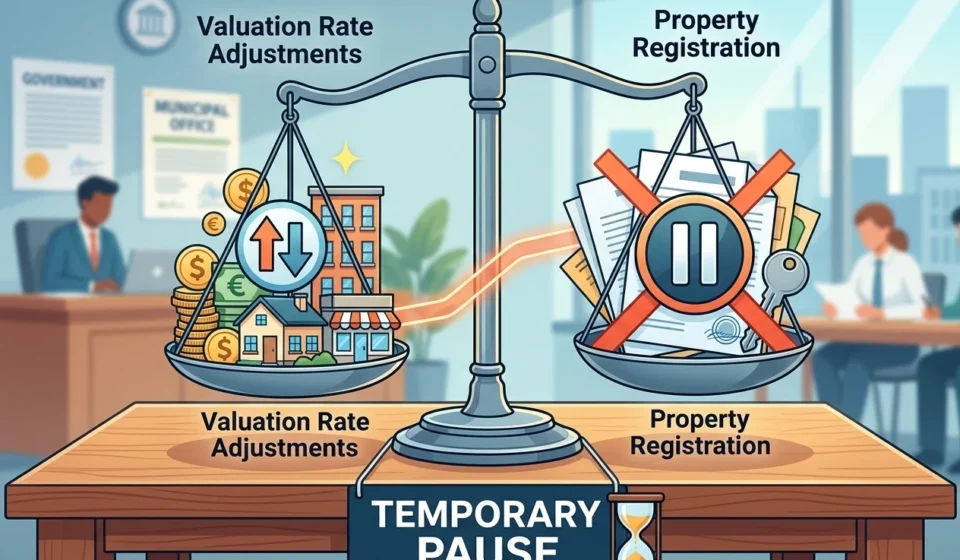

Property buyers and sellers faced temporary disruption as administrative authorities adjusted valuation rates, taxes, and registration requirements for real estate transfers. The pause created uncertainty for families waiting to complete home purchases, investors preparing transactions, and property professionals whose daily business depends on predictable registration procedures.
Why Property Registrations Were Temporarily Delayed
Property registration depends on a chain of official valuations, taxes, fees, documents, and verification procedures. When authorities revise the official value assigned to land or buildings, registration offices must update the figures used to calculate applicable charges before transactions can proceed normally.
A recent episode in Rawalpindi illustrates how quickly such administrative changes can affect the property market. Property registrations across the district were suspended while revised Deputy Commissioner valuation rates were awaited. Reporting published in July showed that the absence of updated rates had brought transactions to a standstill, with stakeholders reporting that registrations had stopped for weeks.
The disruption was not simply a technical matter. A property transaction often involves several people working around a specific completion date, including buyers, sellers, banks, lawyers, property dealers, stamp vendors, and registration officials. When the official valuation schedule changes or remains unavailable, the entire chain can be forced to wait.
Valuation Rates Have a Direct Effect on Property Costs
Official valuation rates are used by governments to determine the taxable or assessable value of real estate. They can influence stamp duty, registration charges, capital value taxes, advance taxes, and other transaction related costs, depending on the jurisdiction and type of property.
Pakistan also has separate valuation frameworks at the provincial and federal levels. The Federal Board of Revenue maintains valuation information for immovable property in numerous cities, including Karachi, Lahore, Islamabad, and Rawalpindi. Its official valuation resources provide city specific tables and notifications that can be checked by taxpayers and property professionals.
Federal Board of Revenue property valuation information provides an important reference point for checking applicable federal valuation schedules before completing a transaction.
Rawalpindi Provides a Clear Picture of the Administrative Impact
In Rawalpindi, the valuation issue became particularly visible at the start of the new financial year. Reports indicated that registrations were halted after the district administration had not issued revised official property valuation rates. Property dealers said the suspension affected residential, commercial, and other property transactions and left buyers and sellers uncertain about the eventual cost of completing their deals.
The situation later moved toward resolution when the new Deputy Commissioner retained the previous financial year’s valuation rates for the 2026 to 2027 period. Registrations subsequently resumed through biometric verification and an online registration system, although several taxes and processing charges were revised.
The episode also demonstrated why the timing of government notifications matters. Even when the final valuation rate does not increase, a delay in confirming the applicable rate can prevent registrars from calculating transaction charges with certainty. A buyer who has already negotiated a price may therefore be unable to complete the purchase until the administrative framework becomes clear.
Buyers Could Still Face Higher Transaction Expenses
Keeping an official property valuation unchanged does not necessarily mean that the overall cost of registration remains unchanged. Taxes, processing charges, verification fees, mutation charges, and other government levies can change independently.
For property buyers, the distinction is significant. The agreed sale price is only one part of the financial calculation. Before signing a final agreement, buyers should determine which official valuation applies, how stamp duty is calculated, what federal taxes are due, and whether registration or mutation charges have changed.
Property sellers also need to review their obligations before accepting a completion date. A change in tax treatment can affect the amount received at closing, particularly where withholding taxes or capital gains obligations apply.
What Buyers and Sellers Should Check
- Confirm the latest official valuation applicable to the property’s location and category.
- Verify current stamp duty, registration fees, mutation charges, and applicable taxes.
- Check whether the transaction requires biometric verification or additional digital documentation.
- Keep evidence of payments, challans, ownership records, and previous correspondence with registration authorities.
- Ask the relevant registration office whether pending transactions will be processed under the old or revised schedule.
Digital Registration Can Reduce Delays, but It Cannot Replace Official Updates
Punjab has been moving more land services into digital systems. The Punjab Land Records Authority provides online services for property registration, e stamping, land records, and valuation related procedures. Its registration guidance explains the process from challan creation and fee payment through document verification and final registration.
Punjab Land Records Authority registry guidance also shows how digital registration is intended to reduce dependence on manual procedures while maintaining formal verification of ownership transfers.
Digital systems can make transactions faster once the relevant information is available. They cannot, however, solve a delay caused by an authority that has not yet issued or updated the underlying valuation schedule. The software can calculate a fee only after the correct official rate has been entered into the system.
Why Temporary Registration Pauses Matter to the Wider Property Market
A short administrative interruption can have effects beyond the registration office. Buyers may postpone moving into homes they have purchased. Sellers may delay reinvesting proceeds. Developers can face slower project sales, while property dealers may see their pipelines of pending transactions grow.
For families, the consequences can be particularly stressful. A home purchase is often tied to a mortgage, school arrangements, relocation plans, rental commitments, or the sale of another property. A delay of several weeks can therefore create expenses that are invisible in the official registration statistics.
Commercial transactions can face even greater pressure. Businesses purchasing offices, warehouses, shops, or development land may have financing arrangements and contractual deadlines linked to registration. An uncertain government valuation can complicate those schedules and make it harder for buyers and sellers to determine the final cost of a transaction.
Clear Notifications Are Critical for Market Confidence
The recent disruption reinforces a basic principle of property administration: valuation changes need to be communicated clearly and implemented consistently. Buyers and sellers can adapt to higher costs when they know what those costs are. Uncertainty is harder to manage.
Authorities can reduce disruption by issuing valuation schedules before the beginning of a new financial period, coordinating tax notifications with registration offices, and ensuring that digital registration platforms receive updated rates at the same time. Clear instructions for transactions already submitted but not yet completed can also prevent disputes.
For citizens, the safest approach is to verify the applicable rates and registration requirements immediately before making substantial payments or committing to a closing date. Official government portals should take priority over informal rate sheets, outdated documents, or verbal assurances from intermediaries.
What the Pause Means for Property Transactions
The temporary registration disruption shows how closely property markets are tied to government valuation and tax administration. A transaction that appears straightforward between a buyer and seller can depend on several public systems operating at the same time.
As revised valuation structures become effective, buyers and sellers should expect registration costs to reflect the latest applicable rules rather than relying on figures from an earlier financial year. Property professionals can help clients prepare, but the final calculation should be verified through the responsible government authority.
For people already holding pending property files, the key question is whether their transaction falls under the previous valuation schedule or the revised one. That determination can affect the amount payable and the documents required for completion. Checking the official record before proceeding can prevent a costly surprise at the registration counter.
A Short Pause With Long Lessons for Property Buyers
The temporary halt in property registrations was an administrative disruption, but its consequences reached into ordinary households and businesses. Valuation rates may look like numbers on a government schedule, yet those numbers can determine whether a family can complete a home purchase on time or whether a commercial transaction closes as planned.
Our view is that greater predictability should be the central lesson from the episode. Timely valuation notifications, synchronized tax rules, accurate digital systems, and accessible public guidance can help keep legitimate property transfers moving while protecting government revenue and reducing confusion for citizens.
For anyone preparing to buy, sell, or transfer property, the practical lesson is straightforward: verify the latest valuation, confirm every applicable charge, retain proof of payment, and check the registration status through the official system before committing to a final completion date.