

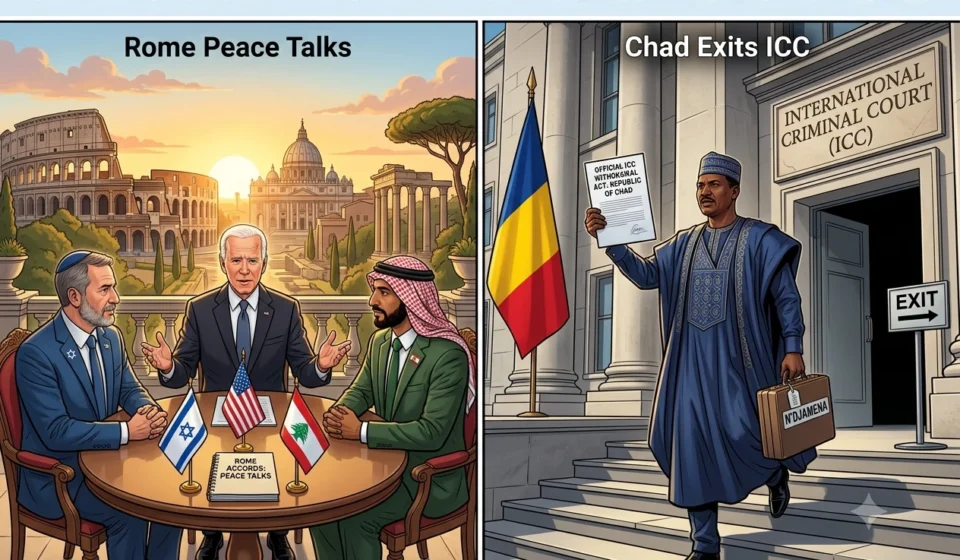

Diplomatic attention shifted to Europe and Central Africa on July 28, 2026, as senior officials prepared for technical negotiations in Rome aimed at strengthening security arrangements between Israel and Lebanon while Chad announced its intention to withdraw from the International Criminal Court. Although these developments unfolded hundreds of miles apart, both carry significant implications for regional stability, international law, and the future of multilateral diplomacy. We are witnessing two distinct stories that reflect the growing complexity of global security and governance, where governments increasingly balance national priorities with international commitments.
Rome Becomes the Center of Israel and Lebanon Security Discussions
Officials from Israel, Lebanon, and international partners gathered for high level technical discussions in Rome with the goal of advancing a practical security framework along one of the Middle East’s most sensitive frontiers. The talks are being supported by the United States, which has continued to encourage diplomatic engagement following previous efforts to reduce tensions across the Israel Lebanon border.
Unlike political summits that often focus on broad declarations, technical meetings typically concentrate on detailed operational issues. Participants examine military coordination, border monitoring, communication channels, and mechanisms designed to reduce the likelihood of accidental escalation. Such discussions rarely generate dramatic headlines, yet they frequently provide the foundation upon which longer lasting agreements are built.
The frontier between Israel and Lebanon has experienced repeated periods of instability for decades. Civilian communities on both sides continue to live with uncertainty whenever security incidents occur. Any framework capable of improving coordination and lowering the risk of conflict could have meaningful humanitarian and economic benefits.
Why Technical Negotiations Matter
Diplomatic progress often begins with practical cooperation rather than sweeping political breakthroughs. Security specialists involved in technical talks generally focus on achievable objectives that can build confidence over time. These may include improving communication between military officials, refining observation procedures, strengthening ceasefire monitoring, and establishing clearer protocols during emergencies.
Such incremental progress can help create conditions that make broader political negotiations more realistic in the future. While no immediate agreement is guaranteed, sustained dialogue reduces misunderstandings that have historically contributed to regional crises.
The United Nations continues to play an important role in monitoring parts of southern Lebanon through its peacekeeping mission. Additional background about ongoing peacekeeping activities can be found through the United Nations Peacekeeping portal.
The United States Continues Its Diplomatic Role
Washington has maintained consistent engagement in efforts to reduce regional tensions across the Middle East. American officials have frequently served as facilitators, encouraging dialogue between parties that have limited direct communication. Previous mediation efforts demonstrated that carefully structured negotiations can produce agreements even in highly challenging political environments.
The Rome meetings represent another example of diplomacy that prioritizes practical outcomes over symbolic gestures. Rather than attempting to resolve every outstanding dispute simultaneously, negotiators are concentrating on security measures that could immediately improve stability.
Regional observers note that successful implementation of even modest confidence building measures may encourage additional diplomatic contacts involving neighboring countries and international organizations.
Communities Continue to Bear the Human Cost of Regional Tensions
Behind every diplomatic meeting are families whose daily routines have been shaped by years of uncertainty. Farmers working near border communities, business owners trying to rebuild local economies, and children growing up amid recurring security concerns all have a direct stake in whether negotiations succeed.
Residents often measure diplomatic progress differently from policymakers. Rather than focusing on formal statements, they judge success through quieter nights, safer roads, functioning schools, and renewed economic activity. Those practical realities remain central to the long term value of any security arrangement.
Chad Announces Its Withdrawal From the International Criminal Court
While diplomats met in Rome, Chad formally announced plans to withdraw from the International Criminal Court, commonly known as the ICC. The decision places renewed attention on the relationship between African governments and international judicial institutions.
The International Criminal Court was established to investigate and prosecute individuals accused of genocide, crimes against humanity, war crimes, and the crime of aggression when national courts are unable or unwilling to pursue such cases. More information about the court and its legal mandate is available through the International Criminal Court.
Withdrawal from the ICC follows legal procedures outlined in the Rome Statute, the treaty that created the court. Although governments have the right to leave the institution, the process generally involves formal notification and does not necessarily affect ongoing obligations related to previously initiated proceedings.
What Chad’s Decision Could Mean
Legal experts suggest that Chad’s announcement may encourage renewed debate about the effectiveness of international justice systems, national sovereignty, and judicial accountability. Supporters of the ICC argue that the institution remains an essential mechanism for addressing the world’s gravest crimes when domestic legal systems fail. Critics have long questioned aspects of the court’s jurisdiction, case selection, and overall effectiveness.
The announcement also highlights broader conversations taking place across several regions regarding the balance between international legal institutions and independent national decision making. These debates have continued for years and remain politically sensitive.
International Reactions Will Be Closely Watched
Governments, legal scholars, and diplomatic organizations are expected to study Chad’s announcement carefully. Responses may vary depending on political priorities, regional alliances, and differing interpretations of international law.
Some observers anticipate discussions within African regional organizations regarding future cooperation with international judicial bodies. Others believe attention will remain focused on ensuring accountability through domestic legal institutions regardless of membership in international courts.
Two Separate Events Reflect a Changing Global Landscape
At first glance, security negotiations in Rome and Chad’s decision regarding the ICC appear unrelated. Yet both developments illustrate how governments increasingly seek solutions that align with their national interests while navigating international partnerships.
The Rome discussions represent diplomacy through dialogue, technical expertise, and confidence building. Chad’s announcement reflects continuing questions about how states engage with international legal institutions. Together they underscore the reality that modern foreign policy extends beyond military considerations into law, governance, humanitarian concerns, and international cooperation.
What Comes Next
Attention will now focus on whether the Rome negotiations produce measurable progress toward reducing security risks between Israel and Lebanon. Even limited agreements involving communication procedures or border coordination could contribute to greater regional stability if effectively implemented.
At the same time, Chad’s withdrawal process is likely to generate continued legal and diplomatic discussion within international organizations and among member states of the International Criminal Court. The pace and impact of that process will depend on both domestic political decisions and international engagement in the months ahead.
Both stories serve as reminders that diplomacy rarely advances through dramatic moments alone. More often, meaningful progress emerges from detailed negotiations, careful legal procedures, and sustained engagement among governments seeking to manage difficult challenges in an increasingly interconnected international system.