

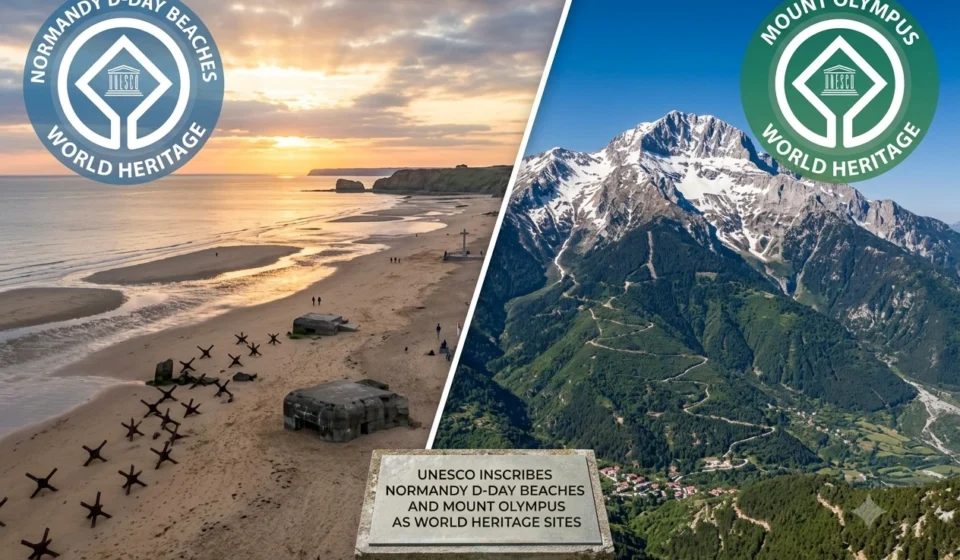

The stories of humanity often live far beyond books and museums. They remain etched into coastlines, mountains, and landscapes where history unfolded and cultures took shape. On July 28, 2026, UNESCO expanded that living record by officially adding France’s Normandy D Day beaches and Greece’s Mount Olympus to the World Heritage List. The decision recognizes two places that represent very different chapters of human civilization, yet both continue to inspire millions through remembrance, heritage, nature, and shared identity.
The latest inscriptions celebrate landscapes that have influenced the course of history for thousands of years. One stands as a solemn reminder of sacrifice during the Second World War. The other rises as one of the most iconic mountains in European mythology and biodiversity. Together, they highlight UNESCO’s continuing effort to preserve locations that tell humanity’s most meaningful stories for future generations.
Normandy beaches become a permanent symbol of courage and remembrance
The Normandy landing beaches hold extraordinary historical significance. On June 6, 1944, Allied forces launched one of the largest amphibious military operations ever attempted, beginning the liberation of Western Europe from Nazi occupation. The beaches became the setting for immense bravery, devastating loss, and a turning point that ultimately changed the outcome of the Second World War.
Visitors walking across the sands today often describe a powerful contrast between the peaceful scenery and the events that unfolded there more than eight decades ago. Gentle waves wash against the shore where thousands of soldiers once landed under intense enemy fire. Memorials, cemeteries, preserved bunkers, and museums throughout Normandy continue to tell deeply personal stories of sacrifice, resilience, and international cooperation.
Recognition as a UNESCO World Heritage Site provides another layer of protection for these landscapes while acknowledging their universal value. The designation also reinforces ongoing conservation efforts that balance historical preservation with responsible tourism.
For families whose relatives fought during the Second World War, the recognition carries emotional significance. Many continue to visit Normandy to honor loved ones whose names remain engraved on memorial walls or whose graves overlook the coastline they helped liberate.
Mount Olympus earns global recognition beyond mythology
Mount Olympus occupies a unique place in both natural and cultural history. Rising above northern Greece, the mountain has long been associated with ancient Greek mythology as the legendary home of the Olympian gods. For centuries, poets, historians, artists, and travelers have celebrated its dramatic peaks and mysterious atmosphere.
Its importance, however, extends far beyond mythology. Mount Olympus supports remarkable ecological diversity, including rare plants, unique wildlife, ancient forests, and varied alpine ecosystems that have developed across changing elevations. Scientists continue studying the mountain because of its environmental richness and its role in Mediterranean biodiversity.
Hikers frequently describe the changing scenery as they ascend through forests into rocky alpine landscapes where clouds drift around towering summits. Each elevation reveals different habitats that contribute to the mountain’s exceptional environmental value.
The UNESCO designation recognizes both the cultural traditions connected to Mount Olympus and the importance of protecting one of Europe’s most treasured natural environments for future generations.
Why UNESCO World Heritage status matters
World Heritage status represents one of the highest forms of international recognition for cultural and natural sites. UNESCO evaluates nominations through rigorous scientific, historical, cultural, and environmental assessments before granting inscription.
Sites included on the World Heritage List are considered to possess Outstanding Universal Value, meaning their significance extends beyond national borders and belongs to humanity as a whole.
The designation often brings several long term benefits.
- Greater international awareness of cultural and natural heritage.
- Stronger conservation planning and preservation efforts.
- Support for sustainable tourism that respects local communities.
- Expanded educational opportunities for future generations.
- Increased international cooperation in protecting vulnerable landmarks.
More information about the World Heritage program is available through the UNESCO World Heritage Centre, which documents every listed property and its global significance.
A growing World Heritage List reflects humanity’s shared legacy
Each year UNESCO reviews nominations submitted by countries seeking international recognition for exceptional cultural, historical, or natural places. The selection process involves years of research, documentation, conservation planning, and expert evaluation before final approval is granted.
The addition of Normandy and Mount Olympus illustrates the broad scope of the World Heritage List. Some locations preserve remarkable architecture or archaeological remains. Others protect ecosystems, landscapes, or places where defining historical events occurred. Together they represent the diversity of human achievement and the natural world.
The list now spans hundreds of locations across every inhabited continent, encouraging nations to cooperate in preserving sites that belong not only to one country but to global heritage.
Preserving memory while protecting nature
Although the Normandy beaches and Mount Olympus represent different aspects of heritage, they share a common responsibility. Both require careful management to preserve fragile environments while welcoming visitors from around the world.
Increasing tourism can provide economic opportunities for nearby communities, yet it also creates challenges involving environmental protection, infrastructure, and visitor education. Sustainable management plans help ensure that future generations experience these locations without diminishing their historical or ecological value.
Conservation specialists increasingly combine modern technology with traditional preservation techniques. Digital mapping, environmental monitoring, archaeological research, and climate studies all contribute to protecting these internationally significant landscapes.
The emotional power of places that shaped history
Historical landmarks often communicate something that books alone cannot. Standing on the Normandy shoreline allows visitors to imagine the uncertainty faced by young soldiers arriving under impossible conditions. Looking toward the towering peaks of Mount Olympus invites reflection on the myths, beliefs, and natural beauty that influenced one of the foundations of Western civilization.
These experiences create powerful emotional connections across generations. Students, veterans, historians, scientists, families, and travelers each encounter these places through different perspectives, yet many leave with a stronger appreciation for the events, traditions, and ecosystems that helped shape human history.
Educational organizations frequently incorporate visits to both destinations into broader programs covering European history, environmental science, archaeology, mythology, and cultural heritage.
International recognition arrives at a meaningful moment
The recognition comes during a period when many nations continue investing in heritage conservation while addressing challenges created by climate change, urban development, and increasing visitor numbers. Historic sites and protected natural areas face growing pressure from environmental change, making international cooperation more valuable than ever.
UNESCO’s decision sends a broader message that preserving humanity’s shared heritage remains an international responsibility rather than the task of individual countries alone. The designation encourages governments, researchers, conservation experts, educators, and local communities to continue working together.
Additional information about international cultural preservation initiatives can also be found through the International Council on Monuments and Sites, an organization that contributes expert evaluations for many World Heritage nominations.
A lasting tribute for future generations
The addition of the Normandy D Day beaches and Mount Olympus to the UNESCO World Heritage List ensures that two extraordinary landscapes receive global recognition worthy of their lasting importance. One reminds the world of extraordinary sacrifice made in pursuit of freedom. The other celebrates the enduring relationship between nature, mythology, and civilization.
Long after political debates and current headlines fade, these places will continue telling their stories through quiet shorelines, towering cliffs, ancient forests, and mountain peaks that have witnessed centuries of human experience. Their inscription serves not simply as an honor for France and Greece, but as a commitment by the international community to preserve some of humanity’s most meaningful places for generations still to come.