

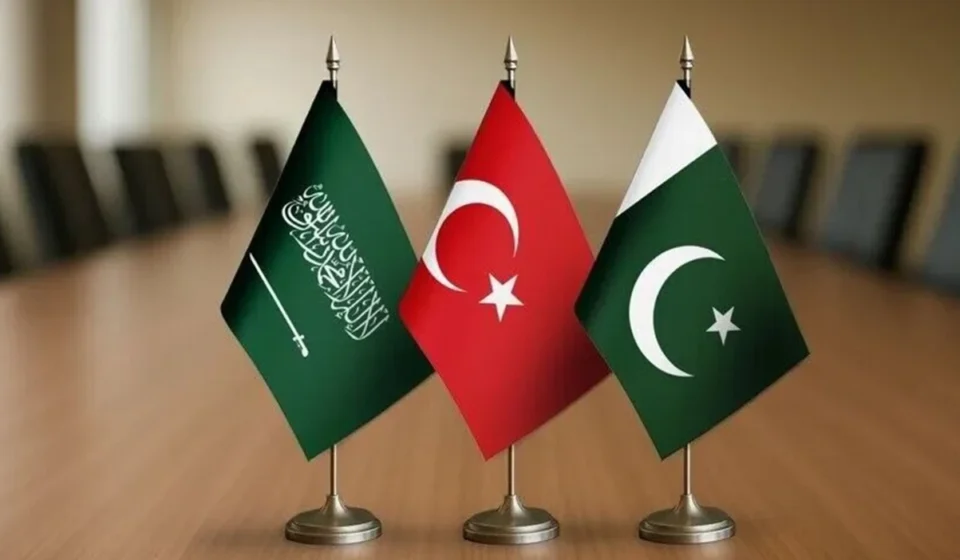

Türkiye, Saudi Arabia and Pakistan have signed the Makkah Joint Defense Agreement, creating a new trilateral security framework under which an armed attack against any one of the three countries will be treated as an attack against all three. The agreement marks a significant expansion of defense cooperation linking a major NATO member, a key Gulf power and South Asia’s largest nuclear armed state, while placing collective security at the center of their strategic relationship.
A New Security Commitment Takes Shape in Makkah
The agreement signed in Makkah on August 8, 2026, brings together three countries whose security interests have increasingly overlapped during a period of intense regional uncertainty. Its central principle is straightforward but consequential: aggression against one member is to be regarded as aggression against the other two.
That commitment gives the agreement importance beyond a conventional military cooperation deal. Rather than limiting cooperation to training, equipment or intelligence sharing, the pact establishes a shared security obligation. The practical response to an attack would still depend on the circumstances and the decisions of the three governments, but the political message is unmistakable. A threat directed at one capital can now become a matter for all three.
The setting also carries considerable symbolism. Makkah is the spiritual center of Islam, and the signing places the agreement within a broader history of religious, diplomatic and security ties among the three countries. For Pakistan and Saudi Arabia in particular, defense cooperation has long been connected to a relationship that extends into economic assistance, military training and shared religious heritage.
Why the Pact Matters for Türkiye, Saudi Arabia and Pakistan
Each country enters the arrangement with different strategic assets and concerns. Saudi Arabia possesses enormous financial resources and sits at the heart of Gulf energy infrastructure and maritime trade. Türkiye has one of the region’s most developed defense industries, substantial military experience and a strategic position connecting Europe, the Middle East and the Black Sea. Pakistan brings a large standing military, extensive operational experience and an established defense relationship with Saudi Arabia.
Those capabilities are complementary. Saudi Arabia can provide financial and industrial capacity. Türkiye can contribute advanced defense technology, manufacturing expertise and military capabilities. Pakistan brings manpower, military experience and longstanding security cooperation with the Kingdom.
The combination gives the agreement a geographic reach that neither a purely Gulf alliance nor a South Asian defense arrangement could achieve on its own. It connects the Arabian Peninsula with Anatolia and South Asia, creating a strategic corridor across some of the world’s most sensitive regions.
The Pact Builds on an Earlier Pakistan Saudi Defense Agreement
The trilateral agreement does not emerge from a vacuum. Pakistan and Saudi Arabia already signed a Strategic Mutual Defence Agreement in September 2025. That agreement established the principle that aggression against one country would be considered aggression against both.
The bilateral pact became increasingly significant as regional tensions intensified in 2026. Saudi Arabia has relied on close defense relationships to strengthen its security, while Pakistan has repeatedly described the Kingdom as an important strategic partner. Dawn’s reporting on Pakistan Saudi security cooperation has documented the depth of that relationship, including military coordination and Pakistan’s deployment of aircraft and personnel to Saudi Arabia during heightened regional tensions.
Türkiye’s eventual participation represents a major enlargement of that framework. Earlier in 2026, Turkish officials acknowledged discussions involving a possible defense arrangement with Pakistan and Saudi Arabia, although an agreement had not yet been signed at that stage. The progression from exploratory talks to a formal trilateral pact represents a substantial diplomatic development.
What the Collective Defense Clause Could Mean
The phrase “an attack on one is an attack on all” is likely to attract the most attention because of its resemblance to collective defense provisions found in other military alliances. Yet the wording should not automatically be interpreted as meaning that a war involving one member would produce an identical military response from the other two.
Defense agreements generally require governments to determine the nature of an attack, consult with one another and decide what assistance is appropriate. That assistance can take different forms, including intelligence sharing, logistical support, air defense, military deployments, diplomatic backing or direct military action.
The significance of the Makkah agreement therefore lies partly in deterrence. An adversary considering military action against one member must now account for the possibility that the conflict could widen. Even without troops immediately crossing borders, that uncertainty can alter strategic calculations.
Three areas will be particularly important
- Joint military planning and exercises that establish how the three armed forces would coordinate during a crisis.
- Intelligence and early warning arrangements designed to identify emerging threats before they become attacks.
- Defense industry cooperation involving aircraft, drones, naval systems, air defense and other military technologies.
The effectiveness of the pact will ultimately depend less on the language of the signing ceremony than on the institutions created afterward. A collective defense promise becomes more credible when military commands know who communicates with whom, what forces are available and how decisions would be made under pressure.
Türkiye Brings a Powerful Defense Industry to the Partnership
Türkiye’s role could prove especially important because Ankara has developed a substantial domestic defense manufacturing sector. Turkish companies have expanded their production of unmanned aircraft, naval platforms, armored vehicles, missiles and other military systems, while the country’s armed forces have accumulated extensive operational experience.
Türkiye and Pakistan already maintain close defense ties. Their cooperation has included naval projects, aircraft modernization and defense technology. Saudi Arabia has also sought deeper relationships with Türkiye as Riyadh works to broaden its military partnerships and develop greater domestic defense capacity.
For Ankara, the agreement also provides another avenue for strategic engagement across the Gulf and South Asia. Türkiye is already a member of NATO, meaning its participation in the Makkah agreement adds a distinct dimension to the country’s increasingly diversified network of security relationships.
Saudi Arabia Seeks Greater Strategic Security
For Riyadh, the pact comes at a time when questions surrounding regional security have become increasingly difficult to separate from energy infrastructure, missile threats, maritime routes and the wider competition among regional powers.
Saudi Arabia has spent years investing heavily in military modernization while maintaining security partnerships with major international powers. The new agreement does not necessarily replace those relationships. Instead, it gives Riyadh another layer of strategic cooperation with two countries that possess significant military capabilities.
The Pakistani relationship is particularly notable because Islamabad has maintained a longstanding military presence and training relationship with Saudi Arabia. Earlier reporting has described the two countries’ defense ties as institutional and extending well beyond any single regional crisis.
The new trilateral framework could therefore be viewed as an attempt to build redundancy into regional security. If one diplomatic or military relationship becomes strained, Saudi Arabia would have additional partners with established interests in its security.
Pakistan Gains a Broader Security Framework
Pakistan also stands to gain from the arrangement. Islamabad has historically maintained close military relations with Saudi Arabia, while its relationship with Türkiye has grown through defense production, diplomatic coordination and strategic cooperation.
Bringing both relationships into one collective framework gives Pakistan a stronger institutional connection with two influential regional powers. It could also create opportunities for greater defense industrial cooperation and joint military training.
At the same time, Pakistan will have to manage the obligations that come with a mutual defense pact. Collective security can strengthen deterrence, but it can also create difficult choices if one member becomes involved in a conflict that the others would prefer to avoid.
The Regional Impact Could Extend Far Beyond the Three Signatories
The agreement is likely to be closely watched across the Middle East, South Asia and beyond. Neighboring states will assess whether the pact remains narrowly defensive or develops into a wider strategic institution with permanent military structures and additional members.
India, Iran and other regional governments will have particular reasons to examine its future direction. That does not mean the agreement should automatically be interpreted as being directed against any one country. Pakistani officials previously described discussions about expanding the Saudi Pakistan framework as a means of strengthening regional cooperation rather than establishing an alliance against a specific state.
That distinction matters. The credibility of the new arrangement may depend partly on whether the three governments present it as a defensive mechanism designed to prevent conflict rather than as the foundation of a rival military bloc.
What Happens After the Signing
The signing ceremony is only the beginning. The next stage will reveal whether the Makkah Joint Defense Agreement becomes a durable security institution or remains primarily a political commitment.
We should expect attention to focus on several practical questions: whether the three countries establish permanent coordination mechanisms, how frequently their armed forces conduct joint exercises, whether intelligence sharing becomes institutionalized and whether defense procurement programs are coordinated.
Another important question will be the treatment of future crises. The real test of any mutual defense agreement arrives when one member faces an actual security threat. The speed, scale and form of assistance provided during such a crisis would determine how seriously potential adversaries view the pact.
For ordinary people across the three countries, the most meaningful measure may ultimately be whether the agreement contributes to stability rather than simply increasing military commitments. Security partnerships matter when they reduce the likelihood that families will experience war, displacement, economic disruption or prolonged uncertainty.
A Significant Shift in Regional Security
The Makkah Joint Defense Agreement represents a major new chapter in relations among Türkiye, Saudi Arabia and Pakistan. By placing collective defense at the center of their partnership, the three governments have moved beyond years of bilateral military cooperation toward a formal trilateral security commitment.
Its long term significance will depend on what follows the signing. If the agreement produces deeper military coordination, shared planning and credible deterrence, it could become one of the more consequential regional security arrangements of the decade. If implementation remains limited to political declarations, its impact will be more modest.
For now, however, the message from Makkah is clear. Türkiye, Saudi Arabia and Pakistan are declaring that their security interests are increasingly interconnected, and that an attack on one member will no longer be viewed solely as that country’s problem.