

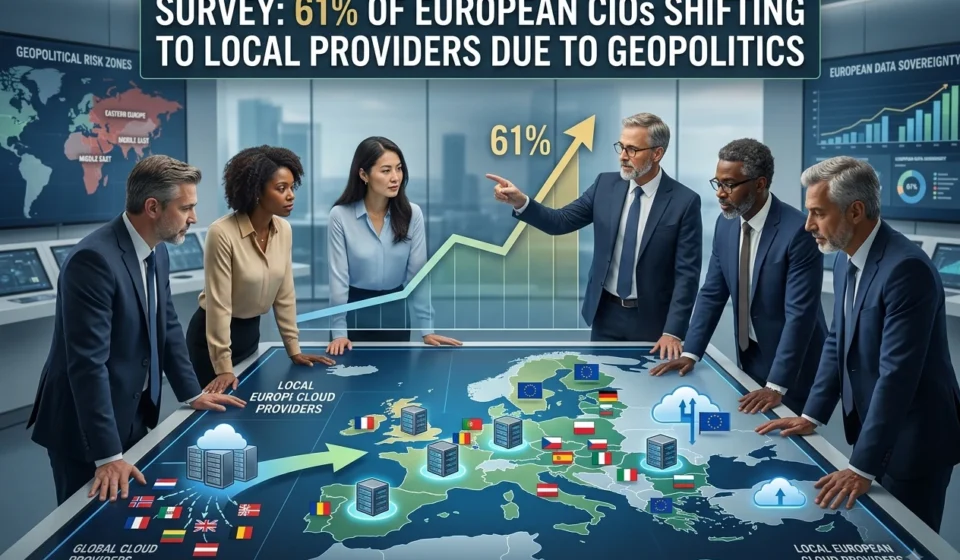
Survey Shows 61% of European CIOs Shifting to Local Cloud Providers Due to Geopolitics

A growing majority of Western European technology leaders are reconsidering where their companies store data, run workloads, and build critical digital systems. A Gartner survey found that 61% of CIOs and IT leaders in Western Europe expect geopolitical factors to increase their reliance on local or regional cloud providers, reflecting a broader push for digital sovereignty and greater control over technology infrastructure.
Geopolitics Is Changing the European Cloud Conversation
For years, cloud procurement was largely framed around price, performance, availability, security, and access to advanced services. Those considerations remain important, but European technology leaders are increasingly asking a different question: what happens if political tensions affect access to the technology their businesses depend on?
That concern is becoming harder for CIOs to separate from ordinary technology planning. Cloud infrastructure can determine where corporate data is stored, which laws apply to it, who can administer critical systems, and how quickly an organization can respond if access to a service is restricted.
Gartner surveyed 241 technology decision makers in Western Europe between May and July 2025. The research found that 61% expected geopolitical factors to increase their use of local or regional cloud providers. More than half also identified open source technology as an important factor in future cloud strategies.
Gartner has described this movement as “geopatriation,” referring to organizations shifting workloads toward sovereign, local, or regional infrastructure because of geopolitical risk. The concept goes beyond traditional cloud repatriation, which usually describes moving workloads away from public cloud services and back to private infrastructure.
Why Digital Sovereignty Matters to European Businesses
Digital sovereignty can sound like a government policy issue, but its consequences reach directly into corporate server rooms, procurement departments, security teams, and boardrooms. A European company may have its data physically stored inside Europe while still depending heavily on software, ownership, support, infrastructure, or administrative controls linked to another jurisdiction.
That distinction matters because data residency alone does not necessarily provide complete technological independence. A company can satisfy a location requirement while remaining dependent on foreign technology providers for operating systems, cloud management tools, cybersecurity platforms, artificial intelligence services, or critical application programming interfaces.
European CIOs are therefore increasingly evaluating sovereignty across the entire technology stack. Gartner’s 2026 technology trends identify geopatriation as a way organizations can reduce geopolitical exposure by moving workloads toward sovereign or regional cloud environments.
The broader European policy debate is also focused on technological independence, resilience, and control. The European Commission has continued to develop policies aimed at strengthening Europe’s technology capabilities and reducing strategic dependencies.
Local Cloud Providers Gain a New Strategic Role
The Gartner findings do not mean European companies are abandoning major global cloud platforms overnight. Large hyperscale providers continue to offer enormous computing capacity, sophisticated artificial intelligence services, global networks, mature security systems, and extensive developer ecosystems.
Instead, the emerging strategy appears more nuanced. Organizations may keep certain workloads with global providers while moving sensitive applications, regulated information, government related systems, or strategically important operations to regional infrastructure.
This approach can give CIOs greater flexibility. A company that operates across several cloud environments may be better positioned to respond if regulations change, international relations deteriorate, or a provider becomes subject to restrictions that affect a particular market.
For local European cloud companies, the shift could create an important competitive opening. Providers that can demonstrate strong security, reliable infrastructure, transparent ownership, European jurisdiction, and credible operational resilience may find themselves competing on factors that extend well beyond conventional cloud pricing.
Open Source Is Becoming Part of the Sovereignty Strategy
The growing interest in open source is another important part of the story. Gartner’s research found that more than half of the surveyed technology leaders expect open source to play an important role in future cloud strategies.
Open source does not automatically make an organization sovereign. Companies still need infrastructure, skilled engineers, security processes, reliable maintenance, and clear governance. However, software with accessible source code can provide organizations with greater visibility into the technologies they operate and reduce dependence on a single commercial vendor.
For European businesses, that flexibility can be especially attractive when technology decisions are being evaluated through the lens of long term resilience. A system that can be moved between providers or operated on infrastructure controlled by the organization may offer greater strategic options than a system deeply tied to one proprietary ecosystem.
That does not make open source a universal replacement for commercial technology. Enterprise leaders must still consider support, security updates, integration requirements, staffing, compliance, and total cost of ownership. The attraction lies in having more choices when circumstances change.
The Risks Go Beyond Data Location
The traditional European sovereignty discussion often centered on where personal or sensitive information was stored. That remains a major concern, particularly for organizations subject to strict regulatory requirements. But geopolitical uncertainty expands the question.
CIOs must consider whether a foreign government could influence a technology supplier, whether sanctions could affect service availability, whether cross border legal demands could create conflicts, and whether an organization could continue operating if access to a critical service were interrupted.
These questions turn cloud architecture into a business continuity issue. A technology decision made for convenience today can create dependencies that become expensive to remove later.
Gartner’s broader research points in the same direction. The company expects more than 75% of enterprises outside the United States to have a digital sovereignty strategy by 2030. That projection suggests sovereignty is moving from a specialized concern into mainstream enterprise planning.
What CIOs Should Consider Before Moving Workloads
The 61% figure should not be interpreted as a recommendation to move every workload to a domestic provider. A rushed migration could create new security, reliability, cost, and performance problems.
Instead, organizations considering greater cloud sovereignty should begin with a detailed assessment of their existing dependencies. The most useful questions are practical.
- Which applications contain the most sensitive or strategically important data?
- Which cloud services would be difficult to replace if access were disrupted?
- Which technology contracts create significant dependence on a single provider or jurisdiction?
- Can critical workloads be moved between providers without major redesign?
- Which systems require European jurisdiction or stronger operational control?
- Where could open source alternatives reduce unnecessary vendor dependence?
Companies should also calculate the cost of maintaining flexibility. Multi cloud and hybrid strategies can increase resilience, but they can also increase operational complexity. Skilled personnel, monitoring systems, security controls, backup arrangements, and governance processes all have to work across multiple environments.
Europe’s Cloud Market Could Become More Diverse
If the trend continues, Europe’s cloud market could become less concentrated around a small number of global platforms. Local providers, telecommunications companies, data center operators, software vendors, and public sector technology initiatives could all gain greater importance.
The shift could also encourage more investment in European data centers and regional computing capacity. That matters beyond ordinary enterprise applications because artificial intelligence is increasing demand for large amounts of computing power and high speed data infrastructure.
At the same time, European companies will still need access to global innovation. Artificial intelligence models, developer tools, specialized databases, cybersecurity services, and other technologies often have international supply chains. Complete technological isolation would be difficult and, for many organizations, economically counterproductive.
The more realistic direction is selective independence. European organizations can seek control over their most sensitive systems while continuing to use global technology where the benefits outweigh the geopolitical exposure.
A Strategic Shift Rather Than a Sudden Cloud Exodus
The significance of Gartner’s survey lies less in the prospect of a mass departure from global cloud providers and more in how CIOs are changing the criteria used to make infrastructure decisions.
Price and performance are no longer the only measures of cloud value. Jurisdiction, ownership, portability, operational control, supply chain resilience, and the ability to maintain service during geopolitical disruption are becoming part of the calculation.
For European technology leaders, that means cloud architecture is increasingly connected to corporate resilience. The decision about where a workload runs can influence whether a company can continue operating when political conditions change unexpectedly.
We should therefore view the 61% figure as a signal of a broader strategic adjustment. European businesses are not necessarily turning away from global cloud technology. They are seeking more control over when, where, and how they depend on it.
That distinction may define Europe’s cloud strategy for years to come. The strongest organizations will likely be those that can combine the scale and innovation of global infrastructure with the control, portability, and resilience demanded by a more uncertain geopolitical environment.