
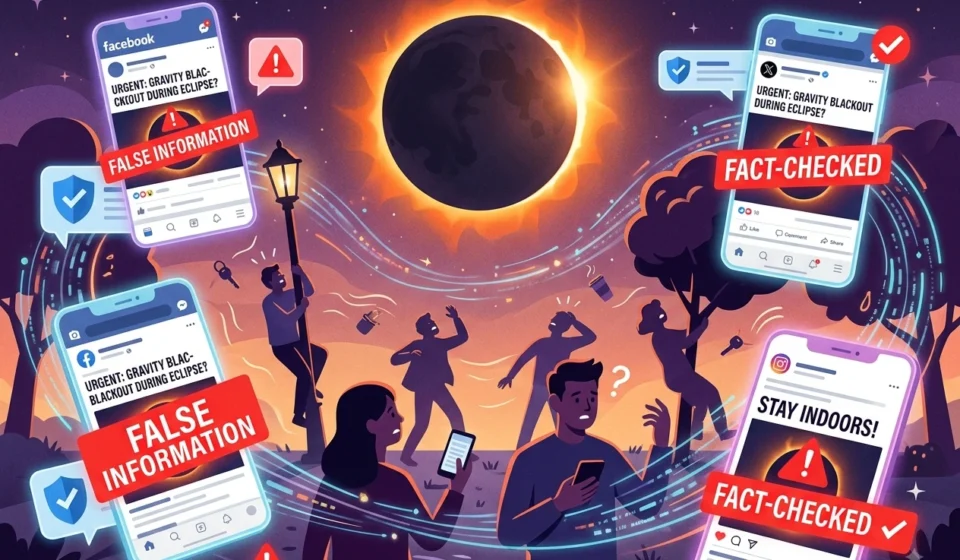

A viral claim warning that Earth would lose gravity for seven seconds on August 12, 2026, has surged across social media just as a real total solar eclipse arrives, prompting scientists and online platforms to push back against a frightening but scientifically baseless story. The rumor has tied an ordinary astronomical alignment to claims of floating people, falling objects, mass casualties and a supposed secret NASA operation, creating confusion around an event that astronomers have predicted for years.
NASA Says Earth Will Not Lose Gravity
The central claim is false. Earth will not suddenly stop exerting gravitational force for seven seconds, and there is no credible scientific evidence that the August 12 eclipse could produce such an event.
NASA has previously addressed the rumor directly, explaining that Earth’s overall gravitational force is determined by the mass of the Earth system. A temporary solar eclipse does not remove Earth’s mass, alter its gravitational field in the dramatic way described by the posts, or create a period during which people and objects would become weightless.
The agency’s explanation is consistent with basic physics. The Sun, Moon and Earth are constantly interacting gravitationally, and their positions can be calculated with extraordinary precision. The changing gravitational influence of the Moon and Sun produces familiar effects such as tides, but their alignment during a solar eclipse does not switch Earth’s gravity off.
NASA’s eclipse information provides a useful reference for separating the genuine astronomical event from the fictional claims circulating online.
How the Seven Second Story Became Viral
The “gravity blackout” narrative did not emerge from an astronomical forecast. Earlier versions circulating online claimed that a secret NASA project called “Project Anchor” had been created to prepare for an approaching gravitational catastrophe. Posts attached precise sounding details to the story, including an alleged duration of about seven seconds, a supposed date and time, enormous casualty estimates and claims of secret government preparations.
Fact checking investigations found no credible evidence that such a NASA program exists. The story appears to have gained momentum through repeated social media posts, short videos and copied text that presented invented material as though it came from confidential government documents.
That formula is particularly effective online because it combines a real date with a fictional threat. August 12, 2026 is indeed the date of a major total solar eclipse. Once that fact is placed beside an invented claim about gravitational failure, the false story can appear more plausible to people encountering it without context.
The Real Solar Eclipse on August 12
There is a spectacular celestial event taking place on August 12, but it is not a gravity emergency. NASA says the total solar eclipse will cross Greenland, Iceland, northern Russia, the Atlantic Ocean, Spain and a small part of Portugal. A partial eclipse will be visible across a much broader area, including portions of North America, Europe and northwestern Africa.
A solar eclipse occurs when the Moon passes between Earth and the Sun and casts its shadow across part of Earth’s surface. During totality, observers positioned within the Moon’s darkest shadow can see the Sun’s bright disk completely covered, revealing the faint solar corona around it.
NASA’s detailed August 12, 2026 eclipse guide shows that totality will generally last less than two minutes for people along much of the path, with some locations experiencing slightly longer periods. Nothing in the eclipse’s geometry indicates a temporary collapse of Earth’s gravitational force.
Why an Eclipse Cannot Turn Gravity Off
The confusion partly comes from the dramatic visual nature of an eclipse. Daylight fades, temperatures can change, the horizon can develop an unusual glow and the Sun appears to disappear behind the Moon. Those effects can feel extraordinary, but none means that Earth’s physical laws have stopped operating.
The Moon’s shadow blocks sunlight. It does not block gravity.
NASA explains that the Sun, Moon and Earth must be aligned in a particular way for an eclipse to occur. The Moon’s orbit around Earth is also tilted relative to Earth’s orbit around the Sun, which is why solar eclipses do not happen every month. The alignment is therefore a predictable orbital event rather than an unpredictable gravitational disturbance.
Even during totality, people remain firmly anchored to Earth’s surface. Vehicles remain on the ground, oceans remain held by Earth’s gravity and satellites continue following their established orbits. There is no seven second interval in which the planet becomes weightless.
Why the Hoax Sounds Scientific
The most convincing misinformation often borrows the language of real science. References to gravitational waves, black holes, planetary alignment and astronomical timing can make a fabricated story sound technical even when the underlying claim does not withstand basic scrutiny.
Gravitational waves are real. They are ripples in spacetime produced by accelerating massive objects, including events involving compact stellar remnants. But invoking gravitational waves does not establish that two unseen waves will intersect at a particular location on a particular day and cause Earth’s gravity to disappear.
The distinction matters. A scientific term can be genuine while the conclusion built around it is entirely fictional.
Platform Fact Checks Meet a Fast Moving Rumor
The renewed spread of the claim has also highlighted the difficulty social networks face when false information is attached to a genuine breaking or highly anticipated event. Posts can move rapidly between platforms, while corrections often reach users after the original claim has already been shared with friends and family.
Fact checking notices and warning labels can help, but users also play a crucial role. A dramatic video claiming that NASA is hiding a global catastrophe deserves the same skepticism as any other extraordinary claim. The presence of thousands of comments or millions of views does not turn an allegation into evidence.
We should also distinguish between repetition and independent confirmation. A post copied across Instagram, TikTok, Facebook, X or messaging services can look like multiple reports when all of the versions trace back to the same unsupported claim.
What People Should Actually Expect During the Eclipse
For people preparing to watch the August 12 eclipse, the practical concern is eye safety rather than gravity. Except during the brief period of totality for observers inside the path of totality, looking directly at the Sun can injure the eyes. Appropriate solar viewing equipment should be used before and after totality and anywhere the Sun remains partially visible.
NASA recommends proper solar viewing protection rather than ordinary sunglasses. People outside the path of totality will experience a partial eclipse and should never assume that reduced sunlight makes direct viewing safe.
- Use certified solar viewing equipment designed for direct observation of the Sun.
- Do not treat ordinary sunglasses as eclipse protection.
- Check the eclipse path and local timing before traveling to view totality.
- Rely on established scientific agencies and observatories for eclipse information rather than viral posts.
A Reminder About Checking Extraordinary Claims
The gravity hoax offers a useful lesson beyond this particular eclipse. False claims become especially powerful when they attach themselves to something real. The eclipse is real. The date is real. The Moon’s alignment with the Sun is real. The alleged global loss of gravity is not.
When a post predicts millions of deaths, claims that governments are hiding a catastrophe or presents a supposedly leaked document as proof, the first question should be whether independent, credible evidence exists. Scientific institutions, observatories and established researchers should be able to explain the underlying phenomenon without relying on anonymous screenshots or dramatic social media narration.
For August 12, the evidence points to a rare and visually striking solar eclipse, not a planetary emergency. The sky may darken, the Sun’s corona may briefly appear and millions of people may look upward with wonder. The ground beneath them, however, will remain exactly where it belongs.