

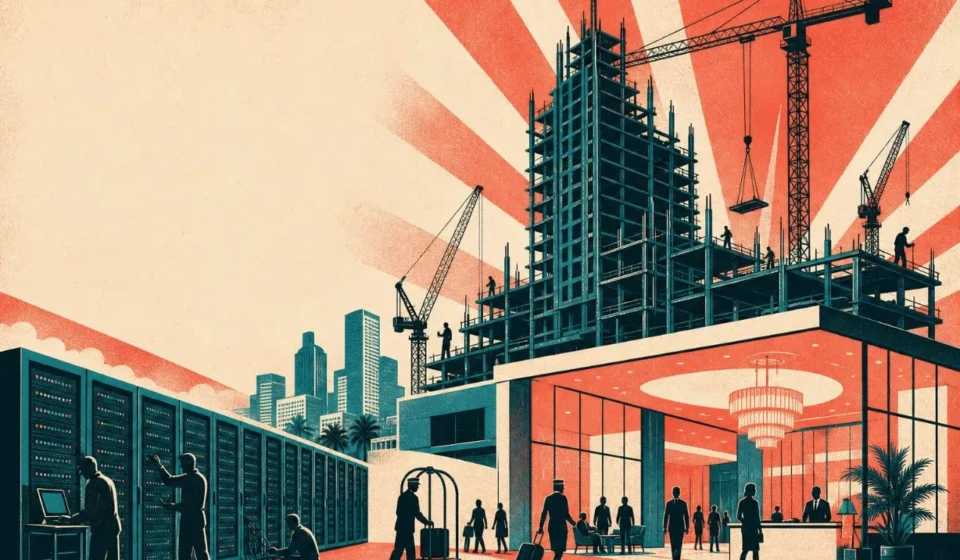
Commercial Real Estate Outlook Highlights Data Center Expansion and Market Stabilization

After several turbulent years defined by rising rates, cautious lenders, and empty office floors, the ground beneath Western U.S. commercial real estate finally feels steadier. That is the core message from Kidder Mathews’ newly released mid year forecast, published August 11, 2026, which paints a picture of a market moving past its most difficult stretch and into something closer to equilibrium. I have spent enough time reading these quarterly reports to know when the language shifts from defensive to cautiously optimistic, and this one reads differently. There is a sense, almost palpable in the data, that brokers, developers, and investors across California, Washington, Oregon, Arizona, and beyond are exhaling after holding their breath for a long time.
A Market Finding Its Balance After Years of Turbulence
The firm’s 2026 Western U.S. Mid Year Market Forecast examines four core property types, office, industrial, retail, and multifamily, and finds a common thread running through all of them: structural shifts and sector specific trends that highlight fundamentals, risks, and new opportunities across the region. :antCitation[]{citations=”7b1786cb-051f-4e85-b070-d2c6c7aadfa9″ injected=”space”} What stands out is not a single dramatic headline but a collection of smaller signals, vacancy leveling off, construction pipelines thinning, and tenant demand becoming more selective yet more durable. Anyone who has walked a half empty industrial park or driven past a stalled construction crane over the past two years will understand why stabilization, rather than explosive growth, counts as genuinely good news right now.
Industrial Real Estate Emerges as the Region’s Steadiest Performer
If there is one sector carrying the report’s optimism, it is industrial. The industrial sector is gaining momentum as leasing activity strengthens and vacancy approaches its cyclical peak, with a sharply contracting development pipeline and steady demand from logistics, ecommerce, manufacturing, and data center users positioning industrial as one of the most durable property types in the West. :antCitation[]{citations=”fa012396-acb8-4852-803f-b88f7bef7d11″ injected=”space”} That last phrase, data center users, is doing a lot of work in this year’s story, and I will get to it shortly.
The numbers back up the narrative. The Western U.S. industrial vacancy rate ended 2025 at 8.3 percent, appearing to have peaked or nearly peaked, which signals the market has moved through its most supply intensive phase and is positioned for gradual tightening through 2026 as new construction continues to decline. :antCitation[]{citations=”22233105-f5ad-4dd1-8179-1af403d3867b” injected=”space”} Leasing activity has also found its rhythm again. Leasing volume increased notably during the latter half of 2025 following a slowdown earlier in the year, with renewed commitments from large occupiers and continued expansion from logistics, manufacturing, and retail distribution users pushing Western U.S. combined leasing totals to just below 235 million square feet, a figure that places the past two years right in line with the pre pandemic 10 year average. :antCitation[]{citations=”c0b8dea4-6eea-421b-8e4d-4db88929d007″ injected=”space”}
Developers, for their part, appear to have learned something from the oversupply cycles of recent years. Rather than chasing speculative projects, builders have shifted toward build to suit and owner user development, a pullback that lowers the risk of future oversupply and should produce a more balanced environment across 2026 and into 2027. :antCitation[]{citations=”e36de9fe-0bec-4e83-96c1-ee317ade089f” injected=”space”} It is a quieter, more disciplined approach than what we saw during the pandemic era logistics boom, and frankly, it feels healthier for everyone involved, from institutional investors to the warehouse workers whose jobs depend on stable occupancy.
Data Centers and the New Power Equation
The most striking undercurrent in this forecast is not square footage at all. It is electricity. Artificial intelligence infrastructure has turned data center development into one of the fastest growing subsegments of industrial real estate, and that growth is straining a resource nobody used to think about when picking a warehouse site: the power grid. Across the Western United States, the binding constraint on industrial site selection has shifted from land and labor to electricity, as energy hungry users including data center operators and advanced manufacturers drive industrial demand while simultaneously straining local grids. :antCitation[]{citations=”97baf7d9-92f9-4894-bc0d-827146e06535″ injected=”space”}
That shift is forcing an unusual level of coordination between developers and utility providers, who are now being pushed to align infrastructure investment in ways that have no recent precedent. :antCitation[]{citations=”64be19e8-6853-4942-a76c-fec559470e38″ injected=”space”} For any company scouting expansion sites in the region, clear ceiling height and truck court depth no longer tell the whole story. Utility lead times now belong on that same checklist, because a property that checks every conventional box can still sit unusable for years while it waits on adequate power delivery. I find this detail almost cinematic in a strange way, gigawatts of computing ambition running headlong into the very physical limits of copper wire and substation capacity.
Retail’s Quiet, Underappreciated Resilience
Retail rarely grabs headlines the way industrial or office space does, yet it continues to be one of the steadiest performers in the Western forecast. Retail remains resilient amid selective growth, supported by limited new supply, low vacancy, and continued demand from grocery, discount, and value oriented concepts. :antCitation[]{citations=”61dded7b-25ca-4bf0-9d82-808dd63a618b” injected=”space”} That resilience makes sense once you consider consumer behavior. Shoppers pulling back on discretionary spending still need groceries, still hunt for deals, and that steady, unglamorous demand has kept well located retail centers full even as other asset classes wobbled.
Office and Multifamily Stabilize, Even If They Are Not Sprinting Ahead
Office space, long the sector everyone loves to write obituaries for, is showing genuine signs of life. Leasing activity is strengthening in select markets, vacancy and sublease availability are beginning to trend downward, and limited new construction is supporting improving fundamentals as the sector moves toward greater balance in 2026. :antCitation[]{citations=”95cb7da2-2798-4cce-a509-05c6eba093c1″ injected=”space”} Multifamily tells a similar story of quiet recovery. The sector enters 2026 on a path toward greater stability as vacancy stabilizes, new supply declines, and affordability challenges continue to support renter demand, with improving capital markets activity and strong renewal rates expected to sustain occupancy and drive steady, measured rent growth as fundamentals rebalance. :antCitation[]{citations=”8d716183-162d-4025-849c-afe3f9c6badf” injected=”space”}
Regional Nuances: Not Every Market Moves at the Same Pace
What makes this forecast worth reading closely rather than skimming for headline numbers is the variation hiding underneath the regional averages. Seattle, for example, tells a more complicated story than the broader Western narrative suggests. Seattle area industrial vacancy reached 9.5 percent in the second quarter of 2026, up from 8.9 percent at year end 2025, as new supply continued to outpace tenant demand, with submarket vacancy ranging widely from 1.8 percent in Skagit and Whatcom County to 12.7 percent in Pierce County. :antCitation[]{citations=”69d67422-5f3b-4898-aac9-27452b2836c0″ injected=”space”} Silicon Valley, by contrast, looks almost overheated by comparison to the rest of the region. Industrial vacancy there fell to 4.2 percent, down 50 basis points year over year, while leasing activity surged 48.2 percent to reach 1.8 million square feet in 2025, and net absorption exceeded 1.58 million square feet for the year, the strongest showing in over a decade. :antCitation[]{citations=”295b8d57-2db1-4216-9948-5c1f115620ab” injected=”space”}
That contrast matters. It is a reminder that talking about “the Western market” as a single entity flattens a lot of local texture, texture that a business owner deciding where to lease space, or a family deciding where to buy a home near new job growth, genuinely needs to understand.
What This Stabilization Means for the People Behind the Numbers
Reports like this one are easy to reduce to spreadsheets and basis points, but behind every vacancy percentage is a leasing agent who finally closed a deal after months of dead air, a warehouse crew whose hours depend on steady throughput, or a family watching apartment rents settle after years of sticker shock. As covered in additional reporting from Connect Commercial Real Estate, the broader picture across office, industrial, retail, and multifamily points toward a region that has absorbed its shocks and is beginning to rebuild on steadier footing.
None of this means smooth sailing ahead. Power constraints on data center growth, uneven vacancy between neighboring counties, and a still cautious lending environment all remain real obstacles. But after a stretch where “uncertainty” was the word of every quarter, it is worth sitting with a report that finally uses the word “balance” instead. For investors, tenants, and communities across the West, that shift in tone might be the most meaningful data point of all.