

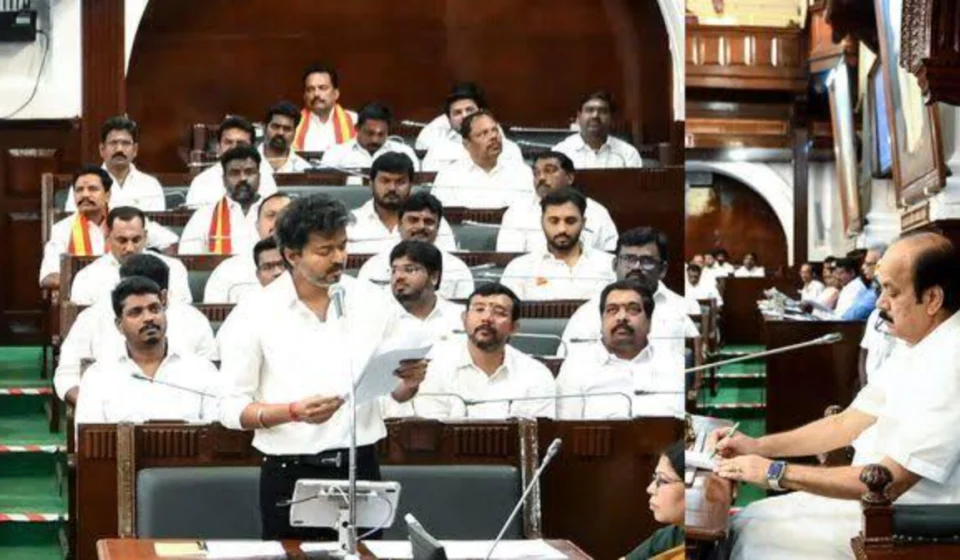

Tamil Nadu’s Legislative Assembly has renewed its long running challenge to India’s national medical entrance system, unanimously adopting a resolution on August 11, 2026, urging the Union government to abolish the National Eligibility cum Entrance Test, or NEET. The resolution points to examination irregularities, repeated concerns over fairness and the pressure placed on students from rural and economically weaker backgrounds.
For thousands of aspiring doctors across Tamil Nadu, the debate is about far more than an entrance examination. It reaches into classrooms, family finances and the hopes of students who spend years preparing for one test that can determine whether a medical career remains within reach. The Assembly’s latest move places those concerns back at the center of India’s debate over how medical education should be accessed.
Tamil Nadu Assembly Renews Its Demand to End NEET
The resolution calls on the Union government to abolish NEET and reconsider the framework governing undergraduate medical admissions. The measure reflects Tamil Nadu’s longstanding position that a single national examination can create unequal conditions for students who come from very different educational and financial circumstances.
Members backing the resolution pointed to irregularities surrounding the examination as evidence that the system can impose risks on students who have invested years of effort preparing for medical school. Concerns over question paper security, examination administration and the reliability of testing procedures have repeatedly intensified public scrutiny of NEET.
The Assembly’s action does not by itself abolish the examination. NEET is governed through the national medical education framework, meaning any fundamental change would require action at the Union level. The resolution is therefore a political and legislative appeal to the central government rather than an immediate change to admission rules in Tamil Nadu.
Why NEET Has Become Such a Sensitive Issue in Tamil Nadu
Tamil Nadu has been one of the strongest critics of NEET since the examination became the principal gateway to undergraduate medical education across India. State leaders and political parties have argued that the test places students from rural and less affluent communities at a disadvantage compared with candidates who can afford expensive coaching programs.
The concern is rooted in the difference between preparation environments. A student attending a well resourced urban school may have access to private tutoring, repeated mock examinations and specialized coaching. Another student may prepare primarily through a government school curriculum, study at home and rely on publicly available material.
Both students ultimately face the same national examination. Supporters of NEET argue that this common standard creates a uniform and merit based admissions process. Critics counter that a uniform test does not necessarily produce equal opportunity when students reach the examination hall after vastly different levels of access to preparation.
This distinction has become central to Tamil Nadu’s argument. The state has historically placed considerable weight on school education and social access to professional courses. Its opposition to NEET is therefore closely connected to a broader political debate about social justice, rural education and the distribution of medical opportunities.
Testing Irregularities Have Intensified the Debate
The Assembly’s resolution comes against a backdrop of continuing concern about the integrity of high stakes examinations in India. When a medical entrance test determines access to some of the country’s most competitive courses, even allegations of question paper leaks, improper administration or inconsistent testing conditions can have consequences far beyond a single examination day.
For students, the stakes are unusually high. Preparation can consume months or years, while coaching and study materials can place a significant financial burden on families. A student who believes an examination was compromised may have little practical opportunity to recover the time, money and emotional energy invested in preparation.
That pressure is particularly significant for families whose children are the first generation to pursue professional education. For them, medical school can represent social mobility as well as a career. A disputed examination result can therefore feel like a setback affecting an entire household rather than simply one applicant.
The Social Justice Argument Behind the Resolution
Tamil Nadu’s opposition to NEET has consistently focused on equal access. State leaders have argued that medical admissions should recognize the performance of students throughout their school education rather than relying overwhelmingly on a single standardized examination.
The argument has particular resonance in rural districts, where students may have fewer coaching facilities and less access to specialized preparation. A national examination can remove differences in the way colleges evaluate applicants, but it cannot automatically remove differences in schooling, household income or access to private instruction.
Critics of the state’s position, however, argue that replacing NEET with state based admissions could create another set of disparities. A national examination provides a common benchmark for students across different school boards and states. Supporters also contend that standardized testing can make medical admissions more transparent by reducing the influence of subjective selection procedures.
That disagreement is unlikely to disappear with the latest Assembly resolution. At its core is a difficult question: should fairness mean giving every applicant the same examination, or should the admissions system account more directly for the different conditions under which students are educated?
Tamil Nadu Has Challenged NEET Before
The August 11 resolution is not an isolated political development. Tamil Nadu has previously passed measures seeking exemption from NEET and has repeatedly asked the Union government to alter the national legal framework governing medical admissions.
Government documents and parliamentary records show that the state has argued for greater control over medical admissions and has questioned whether the existing national framework adequately reflects the educational realities of Tamil Nadu. A Lok Sabha record from 2024, for example, documented the Union government’s position that no proposal was then under consideration to amend the National Medical Commission Act to abolish NEET nationally.
The state has also commissioned studies examining the examination’s impact on students. Tamil Nadu government documents have previously described concerns that NEET could disadvantage poor and rural students, reinforcing the political case for a different admissions model.
What the Resolution Means for Students
Students and families should not interpret the Assembly vote as an immediate cancellation of NEET. Until the Union government changes the national framework and the relevant authorities issue new admission rules, applicants should continue to follow the official NEET schedule and eligibility requirements.
The National Medical Commission remains a key institution in India’s medical education system, while national examination authorities continue to administer the entrance process under the existing framework.
The practical message for students is straightforward. The political debate may be changing, but admission requirements do not change simply because a state legislature passes a resolution. Students planning to seek medical admission should rely on formal notifications from the competent authorities rather than political statements or social media claims.
Why the Dispute Matters Beyond Tamil Nadu
The confrontation between Tamil Nadu and the Union government has implications for the wider Indian education system. NEET was designed to create a common pathway into medical education, but opposition to the examination has raised questions about whether a single national model can adequately serve a country with enormous differences in language, schooling systems, household income and educational infrastructure.
The debate also touches the future supply of doctors. Tamil Nadu has a large and established medical education network, and the state has long argued that admissions should support the needs of its population while preserving opportunities for students from disadvantaged communities.
At the national level, policymakers face a competing responsibility. Medical admissions must be rigorous enough to protect academic standards and ensure that students entering medical school can handle the demands of professional training. At the same time, the selection process must command public confidence and provide students with a credible assurance that their performance is being measured fairly.
A Political Resolution With a Larger Question Behind It
The unanimous adoption of the August 11 resolution gives Tamil Nadu another formal platform from which to press its case against NEET. It also demonstrates that opposition to the examination remains a significant issue in the state’s political discourse.
Yet the next stage lies outside the Assembly chamber. The Union government would have to consider whether to change the national medical admissions framework, while policymakers would need to determine what system could replace NEET without creating new forms of inequality or compromising academic standards.
For students sitting at kitchen tables with textbooks spread before them, that policy argument has a very personal dimension. They are not debating constitutional powers or admission regulations. They are trying to answer a simpler question: whether years of study will give them a fair chance to become doctors.
Tamil Nadu’s latest resolution puts that question firmly before New Delhi once again. Whether it leads to a change in national policy will depend on the Union government, Parliament and the institutions responsible for medical education. For now, the Assembly has made its position unmistakable: the state believes India’s medical admission system should be redesigned around equal opportunity, examination integrity and a broader measure of student achievement.