

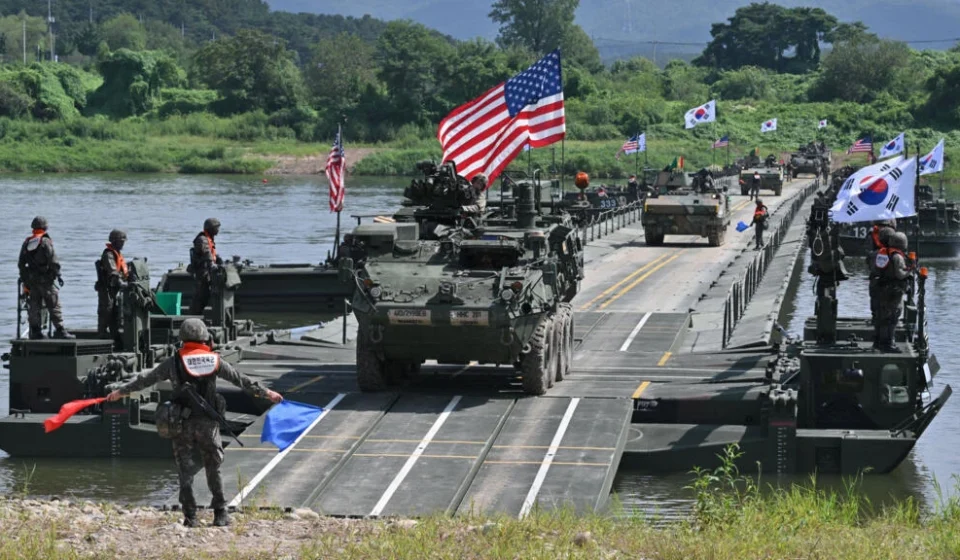

The United States has ordered the Pentagon to substantially reduce upcoming joint military exercises with South Korea, marking a significant adjustment in the way Washington is approaching security on the Korean Peninsula. The decision, announced on August 16, 2026, comes as the administration reassesses military priorities across East Asia and weighs a renewed diplomatic approach toward North Korea.
Washington Moves to Reduce the Scale of Joint Drills
President Donald Trump directed the Pentagon to scale back the exercises rather than cancel them outright. The order came shortly before the annual drills were scheduled to begin, leaving military planners with limited time to alter the scope of activities while preserving portions of the exercise framework.
Trump has argued that the exercises are costly and send an unnecessarily hostile message to North Korea. He has also pointed to his relationship with North Korean leader Kim Jong Un as part of the reasoning behind his position. The administration’s decision therefore carries significance beyond a simple adjustment to military training. It signals that diplomatic calculations with Pyongyang are once again influencing the size and character of US and South Korean military cooperation.
Reuters reported that the decision was made as Washington also considers wider strategic priorities, including tensions involving Iran and the allocation of American military resources. The report noted that the annual Ulchi Freedom Shield exercise was already scheduled to proceed, with the South Korean military maintaining its participation.
Why the Military Exercises Matter to the US South Korea Alliance
For American and South Korean forces, joint exercises are more than demonstrations of military strength. They provide an opportunity for commanders, service members and support units to practice operating together under demanding conditions.
That interoperability can become especially important during a crisis. Military units from two countries must be able to communicate, coordinate logistics, share information and respond to rapidly changing conditions. Training together allows those procedures to be tested before they are needed in an emergency.
The annual exercises also send a message about the strength of the US South Korea alliance. For Seoul, American military readiness on the peninsula remains an important component of deterrence against North Korean aggression. For Washington, combined training demonstrates that American forces stationed in South Korea can operate effectively alongside their South Korean counterparts.
The Pentagon’s own public record has repeatedly highlighted the alliance’s emphasis on combined readiness and extended deterrence. The US South Korea Security Consultative Meeting joint communique also describes continued cooperation on conventional and nuclear deterrence planning.
Ulchi Freedom Shield Faces a New Strategic Question
The immediate focus is the Ulchi Freedom Shield exercise, an annual series of combined military activities designed to strengthen the allies’ ability to respond to threats on the Korean Peninsula. This year’s exercise was expected to involve approximately 18,000 South Korean troops, according to reporting by the Associated Press.
South Korea has proceeded with the exercise while reaffirming its commitment to the bilateral defense relationship. That response is significant because the latest US order does not eliminate the exercises. Instead, it introduces uncertainty over how much field training, maneuver activity and other operational components will remain.
The distinction matters. A smaller exercise can preserve some degree of interoperability while reducing the visible military footprint that Washington believes could complicate diplomatic engagement with Pyongyang. The challenge for military planners is determining how much training can be reduced without weakening the practical readiness that the exercises are intended to maintain.
What a scaled back exercise could mean
Military exercises can be adjusted in several ways without being completely abandoned. The number of participating personnel can be reduced, certain field activities can be shortened, and greater weight can be placed on command post simulations and computer based scenarios.
Some of these changes have precedent. US and South Korean exercises have previously shifted between large field maneuvers and more simulation focused formats, particularly during periods when Washington and Seoul sought diplomatic openings with Pyongyang.
That history makes the latest decision especially notable. It suggests that the administration is not simply looking for savings but is also considering military training as part of a broader diplomatic strategy.
North Korea Is Central to the Calculation
North Korea has historically described US South Korean military exercises as preparation for an attack, while Washington and Seoul have characterized them as defensive training. That opposing interpretation has made military exercises one of the most sensitive issues in relations between the two Koreas.
For residents living within reach of military installations, the debate can feel far removed from abstract discussions about deterrence and diplomacy. Military convoys, aircraft activity and exercises are tangible reminders that the Korean Peninsula remains technically at war decades after the 1953 armistice.
Reducing the scale of exercises could therefore be viewed by supporters as a way to create political space for dialogue. Critics, however, may worry that reducing training could create a gap between diplomatic intentions and military preparedness.
Washington Is Balancing Diplomacy and Readiness
The central question now is whether a smaller exercise can serve both diplomatic and military purposes. The administration appears to believe that the answer is yes, at least for the moment.
That balance is difficult. Deterrence depends partly on an adversary believing that military forces are capable, coordinated and prepared to respond. Diplomacy, meanwhile, sometimes requires governments to reduce actions that the other side interprets as threatening.
The United States has faced this tension before on the Korean Peninsula. During earlier periods of direct engagement between Washington and Pyongyang, large scale military exercises were reduced or suspended. When diplomatic efforts faltered, military training gradually regained importance.
The current policy shift could follow a similar pattern, although its long term direction remains uncertain.
South Korea Faces a Delicate Alliance Test
For Seoul, the decision creates a complicated strategic calculation. South Korea has strong reasons to preserve the US security commitment while also maintaining room for its own diplomatic initiatives toward North Korea.
Any reduction in combined training therefore has two sides. It may lower tensions and support dialogue, but it could also raise questions about whether the alliance is maintaining enough operational preparation for a sudden security crisis.
South Korean officials have so far indicated that the alliance remains intact and that the exercises will continue. That response reflects the importance Seoul places on stability at a time when the regional security environment is already being shaped by competition among the United States, China, Russia and North Korea.
A Broader Shift in East Asian Security Policy
The significance of the Pentagon order extends beyond the Korean Peninsula. American military planners are increasingly required to consider how limited forces and resources should be distributed across the Indo Pacific and other theaters.
That means decisions about training in South Korea cannot be separated entirely from developments elsewhere. Every major exercise requires personnel, equipment, transportation, fuel and planning resources. Reducing one activity can create greater flexibility for other missions.
At the same time, South Korea remains strategically important because of its location and its role in regional security. Any adjustment to the US military posture there will be closely watched by allies and competitors alike.
What Comes Next for US South Korea Military Cooperation
The immediate effects of the order will likely be measured through the details of the exercise itself. The most important indicators will include which training activities are retained, how many American and South Korean forces participate, and whether the reduction becomes a temporary adjustment or part of a longer policy.
There is also a diplomatic question. If Washington hopes the move will encourage North Korea to engage, Pyongyang’s response will matter. A reduction in military exercises could create an opening for dialogue, but it does not by itself resolve the deeper disputes surrounding North Korea’s nuclear weapons, missile programs and relationship with the United States and South Korea.
For American service members and their South Korean counterparts, the issue is more practical. Readiness is built through repetition. Joint procedures that are practiced in training are easier to execute when circumstances become dangerous and time is limited.
For that reason, the US decision should not be viewed simply as a cancellation of military activity. It is better understood as a recalibration of the balance between deterrence, preparedness and diplomacy.
The Larger Stakes for the Korean Peninsula
The Korean Peninsula remains one of the world’s most heavily militarized regions, and small changes in military posture can carry large political consequences. Washington’s decision to reduce the scale of joint exercises reflects an administration willing to reconsider established security practices in pursuit of broader strategic objectives.
Whether that approach produces greater stability will depend on what follows. If reduced exercises create meaningful diplomatic engagement while preserving credible military readiness, the policy could provide Washington and Seoul with additional room to maneuver. If diplomacy fails while training remains diminished, concerns about preparedness could become more pronounced.
For now, the message from Washington is clear: military exercises with South Korea remain part of the alliance, but their scale is being reconsidered as the United States adjusts its wider East Asian strategy. The coming months will show whether that recalibration becomes a temporary measure or the beginning of a more fundamental change in how Washington manages security on the Korean Peninsula.
What readers should watch next
- Whether the Pentagon provides further details about which portions of the exercises will be reduced.
- How South Korean officials assess the impact on alliance readiness.
- Whether North Korea responds with diplomatic outreach, military activity or both.
- Whether Washington maintains the reduced approach in future US South Korea exercises.
The latest development is being closely followed because the US South Korea alliance sits at the intersection of military readiness and diplomacy. The outcome will help clarify whether Washington’s new approach can reduce tensions without compromising the preparedness that has underpinned deterrence on the peninsula for decades.