

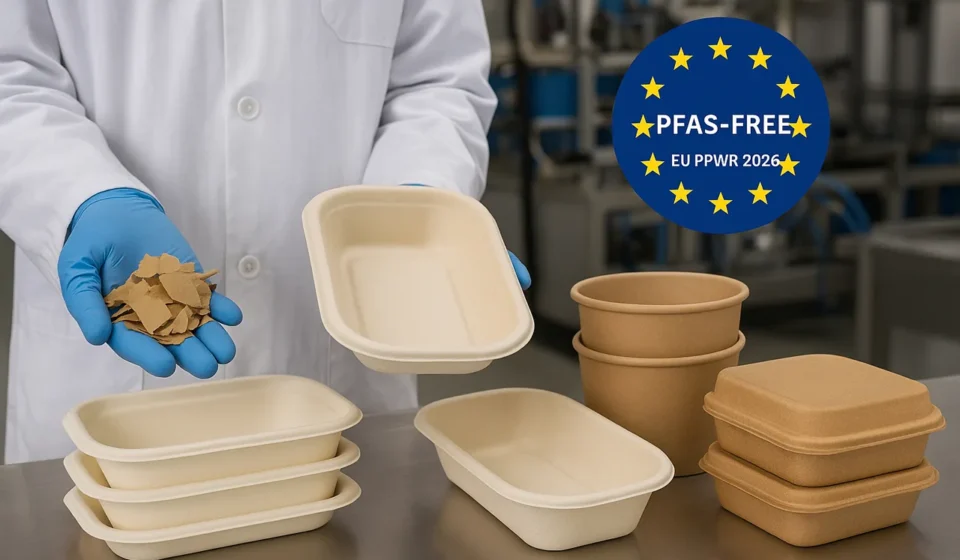

Europe has reached a significant turning point in food packaging regulation. Beginning August 12, 2026, new requirements under the European Union’s Packaging and Packaging Waste Regulation, known as PPWR, restrict food contact packaging containing certain levels of per and polyfluoroalkyl substances, widely known as PFAS or “forever chemicals.” The rules apply across the European single market and place new testing, documentation and compliance responsibilities on packaging manufacturers, importers and businesses that bring packaged products to market.
A major new restriction takes effect across the European market
The August 12 deadline marks the date when Regulation (EU) 2025/40 begins applying across the European Union. The regulation entered into force in February 2025, giving businesses time to prepare for a broader overhaul of packaging requirements covering waste prevention, recyclability, material use and environmental performance.
For food packaging, one of the most closely watched provisions concerns PFAS. These chemicals have been used for properties such as resistance to grease, oil, water and heat. Those characteristics have made them useful in some food service products and packaging applications, but their persistence in the environment has made them a growing regulatory concern.
Under the new PPWR provision, food contact packaging cannot be placed on the EU market when PFAS concentrations reach or exceed specified thresholds, unless another EU law already prohibits the relevant packaging. The regulation establishes separate limits based on the type of PFAS measurement used.
What the PFAS limits mean
The new requirements are more precise than a simple blanket statement that every detectable trace of PFAS is prohibited. The regulation establishes three concentration thresholds that businesses must consider when demonstrating compliance.
- 25 parts per billion for any PFAS measured through targeted PFAS analysis, with polymeric PFAS excluded from that particular quantification.
- 250 parts per billion for the combined concentration of PFAS measured through targeted analysis, including precursor degradation where applicable.
- 50 parts per million for PFAS including polymeric PFAS, with additional documentation requirements when total fluorine exceeds 50 milligrams per kilogram.
These thresholds make laboratory testing and supply chain documentation particularly important. A manufacturer cannot simply rely on a general statement that a package is PFAS free. Companies need appropriate evidence showing that the packaging meets the applicable requirements.
Why PFAS are called “forever chemicals”
PFAS refers to a large family of manufactured chemicals containing highly stable carbon and fluorine bonds. Their durability is part of what made them attractive for industrial applications. The same persistence, however, means many PFAS can remain in the environment for long periods rather than breaking down readily.
Concerns surrounding PFAS extend beyond packaging. Researchers and regulators have examined exposure through drinking water, food, consumer products and occupational environments. Some individual PFAS have been associated with adverse health effects, although the risks differ substantially across the thousands of substances that fall within the broader PFAS family.
For consumers, the new packaging rule therefore represents a preventive approach. Instead of waiting for every individual chemical to be evaluated separately, EU lawmakers have introduced concentration limits that apply to PFAS in food contact packaging as a category defined by the regulation.
The European Commission maintains broader information about food contact materials and chemical safety through its food safety resources, where businesses and consumers can follow the EU framework governing materials that come into contact with food.
What changes for food and packaging companies
The practical effect will extend well beyond packaging factories. Food producers, retailers, importers and other businesses connected to packaged food may need to examine their supply chains more closely.
A package can pass visual inspection and still create a regulatory problem because PFAS cannot be identified simply by looking at a paper wrapper, molded container or coating. Businesses therefore need reliable information from material suppliers and, where necessary, analytical testing.
The regulation also makes the distinction between placing packaging on the market and later distribution important. The European Commission’s implementation guidance explains that placing on the market refers to the first making available of packaging on the Union market. The rules can therefore affect how companies structure manufacturing, importing, filling and distribution operations.
Companies face several immediate compliance priorities
Packaging suppliers should review material specifications and declarations from upstream manufacturers. Food companies should identify packaging components that directly contact food and determine whether coatings, treatments or other components could contain PFAS. Importers should also make sure their suppliers can provide appropriate technical documentation.
That work matters because the PPWR places obligations across a complex commercial chain. A food manufacturer may not produce the packaging itself, yet it can still depend on packaging suppliers to demonstrate that materials meet European requirements.
Testing is another challenge. The Commission has acknowledged that there is not yet one harmonized EU testing methodology for PFAS in food contact packaging. Its implementation approach recommends a stepwise process beginning with total fluorine measurement and moving to more specific analysis when necessary.
What happens to packaging already produced?
The August 12 date has raised questions about existing stocks sitting in warehouses, stores and distribution networks. The Commission’s guidance provides an important distinction.
Food contact packaging placed on the market before August 12, 2026 can remain on the market and does not have to be withdrawn solely because the new PFAS limits have begun applying. However, packaging placed on the market from August 12 onward must comply with the applicable PFAS thresholds. The PPWR does not provide a transitional stock exhaustion period for this specific restriction.
There is also no general exemption simply because packaging contains recycled material. Companies therefore need to consider the chemical composition of recycled inputs as part of their compliance systems.
Why the rule matters beyond Europe
The impact of the PPWR is unlikely to stop at the EU’s borders. Europe represents a huge consumer market, and international packaging manufacturers often prefer to develop products that can satisfy major markets rather than maintain completely separate material specifications.
That could encourage suppliers around the world to reduce PFAS use in food contact applications. Companies selling paper based food containers, takeaway packaging, coated boards and other food contact products may face growing pressure to provide PFAS compliant alternatives even when their manufacturing facilities are outside Europe.
The effect could be especially noticeable for multinational food companies. A global brand may decide that using one PFAS compliant packaging design across several markets is operationally simpler than maintaining different packaging specifications for Europe and other regions.
Consumers may see changes without noticing the reason
For shoppers, the transition may be almost invisible. The familiar paper food container, wrapper or coated package may look exactly the same while its underlying materials have changed.
Some businesses may move toward alternative coatings or barriers that provide grease and moisture resistance without relying on PFAS. Others may change paper grades, manufacturing processes or packaging formats. The goal is not merely to remove one chemical family but to ensure that replacement materials continue to meet food safety requirements.
That last point matters. Replacing PFAS does not automatically make a material safe. Food contact packaging must continue to comply with the broader European framework governing substances that can migrate from packaging into food. The European Commission notes that food contact materials are regulated to control potential chemical transfer and protect food safety.
PFAS restrictions fit into a much larger packaging overhaul
The PFAS provision is only one element of the PPWR. The regulation establishes a wider framework intended to reduce packaging waste and improve the functioning of the EU internal market. It addresses packaging design, waste prevention, recyclability and other environmental requirements alongside chemical restrictions.
That broader approach is significant because Europe is moving away from treating packaging solely as a waste management issue. The materials selected at the design stage can influence whether packaging is recyclable, how much waste it generates and whether it introduces potentially problematic substances into the environment.
For companies, this means compliance cannot be treated as a single laboratory test performed shortly before a product launch. Packaging design, procurement, chemical documentation, manufacturing controls and market surveillance increasingly need to work together.
Enforcement will depend on credible testing and documentation
The new limits create a practical enforcement question: how can authorities identify non compliant packaging when PFAS may be present at extremely low concentrations?
The Commission has recommended a testing sequence intended to make enforcement workable. Total fluorine can provide an initial screening step. If the measured level is above the relevant threshold, additional methods can help determine whether the fluorine is associated with PFAS. More targeted analysis can then address the specific PFAS limits.
Market surveillance authorities are responsible for checking compliance under the EU market surveillance framework. This gives the rule a practical enforcement mechanism rather than leaving compliance entirely to voluntary industry declarations.
A consequential day for European food packaging
August 12, 2026, is therefore more than another regulatory deadline. It marks the start of a new compliance standard for PFAS in food contact packaging across the European Union.
For manufacturers, the immediate task is clear: verify materials, test where necessary and maintain documentation capable of demonstrating compliance. For food companies and importers, the challenge is to understand what is inside packaging purchased from suppliers rather than relying only on its appearance or intended use. For consumers, the change offers another layer of chemical controls around materials that sit directly against the food they eat.
We should also expect the European approach to influence packaging decisions well beyond the products currently covered by the rule. As companies seek materials that work across international markets, the EU’s PFAS limits could become a reference point for global packaging strategies.
The larger message is equally clear. Packaging regulation is increasingly concerned not only with what happens to a wrapper or container after it is discarded, but also with what that material contains while it is being produced, transported, sold and used. The PPWR brings that principle into sharper focus, putting chemical composition alongside waste reduction and recyclability as a central part of Europe’s packaging policy.