

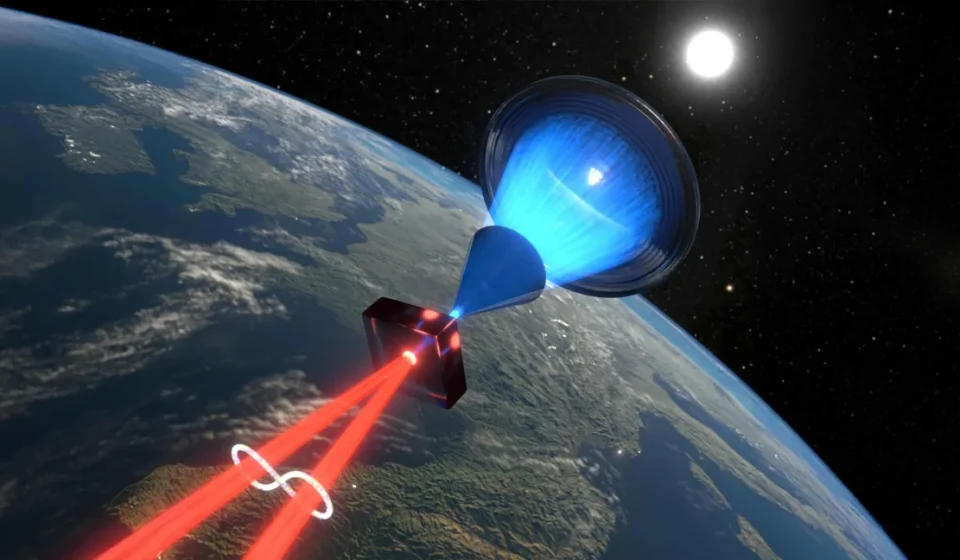

Scientists have demonstrated that ordinary sunlight can be used to generate quantum entanglement, challenging the long standing assumption that high quality entangled photons require carefully controlled laser sources. The experiment produced polarization entangled photon pairs with a Bell state fidelity of 93.9%, showing that the Sun can serve as a practical optical source for a new generation of energy conscious quantum technologies.
Sunlight Replaces the Laser in a Quantum Experiment
Quantum experiments are often associated with carefully isolated laboratories, precision lasers and equipment designed to control even tiny fluctuations in light. The new research points toward a very different possibility. Instead of relying on an electrically powered laser to drive the process, researchers collected natural sunlight and used it to produce entangled photons.
The work was led by Cheng Li, Jasvinder Brar, Michael Küblböck, Jeremy Upham, Hanieh Fattahi and Robert W. Boyd. Their study, published as a preprint, reports the first demonstration that natural, incoherent sunlight can directly drive spontaneous parametric down conversion, a process widely used to create pairs of entangled photons.
The researchers report a Bell state fidelity of 0.939 plus or minus 0.027, which is roughly 94%. They also measured a concurrence of 0.905 plus or minus 0.053 and a purity of 0.919 plus or minus 0.045. These measurements indicate that the generated photon pairs retained strong quantum correlations despite the very different nature of sunlight compared with a laboratory laser.
Why Generating Entanglement From Sunlight Is Difficult
Sunlight may appear bright and orderly to the human eye, but from the perspective of quantum optics it is an exceptionally complicated source. Unlike a laser, sunlight is largely incoherent, meaning its electromagnetic waves do not maintain the same highly controlled phase relationship across space and time.
That difference matters because coherence has traditionally been an important ingredient in preparing and manipulating quantum states of light. Lasers provide a controlled optical field that researchers can tune to the exact conditions required by nonlinear optical experiments.
The team found a way around that limitation by concentrating and filtering sunlight before directing it into the entanglement generating apparatus. A large Fresnel lens first collected the incoming sunlight. The researchers then used optical filters and a conic concentrator to select suitable light and couple it into a multimode fiber.
The resulting beam was further prepared before entering a nonlinear crystal inside a polarization Sagnac interferometer. The crystal was a 10 millimeter periodically poled potassium titanyl phosphate device designed for type II spontaneous parametric down conversion, converting light around 405 nanometers into photon pairs around 810 nanometers.
How the Sun Produces Entangled Photons
Spontaneous parametric down conversion is central to the experiment. When an appropriate pump photon interacts with a nonlinear optical crystal, it can produce two lower energy photons known as signal and idler photons. Under carefully arranged conditions, the properties of those two photons become linked through quantum mechanics.
In this experiment, the optical arrangement was designed so that the two possible paths through the interferometer became indistinguishable. That configuration allowed the researchers to create a polarization entangled state in which measurements of one photon are strongly correlated with measurements of its partner.
The remarkable part is not that sunlight contains quantum particles. All light is quantized into photons. The challenge was demonstrating that naturally incoherent sunlight could provide a sufficiently useful pump source for creating a high quality entangled state.
The researchers collected sunlight outside and concentrated it through a 1 meter by 1.4 meter Fresnel lens. After filtering, the selected light was coupled into a 50 micrometer core multimode fiber. A band pass filter centered near 405 nanometers then prepared the wavelength range used to drive the nonlinear process.
The 94% Fidelity Result Explained
For readers outside quantum physics, fidelity is essentially a measure of how closely the experimentally generated quantum state matches the desired target state. A fidelity of 100% would represent a perfect match.
The measured fidelity of about 94% therefore represents a strong result. The researchers also observed a Bell parameter of 2.5408 plus or minus 0.2171. Because the relevant classical threshold is 2, the measured value exceeded that boundary by 2.94 standard deviations.
That Bell inequality violation is particularly significant because it provides evidence that the observed correlations cannot be fully explained by a conventional local hidden variable model. In simpler terms, the experiment showed correlations with distinctly quantum characteristics rather than merely producing two ordinary light signals that happened to be correlated.
The study also reported an entangled photon generation rate of approximately 1,600 events per second per milliwatt of effective pump power. The authors say this is comparable with laser pumped arrangements when normalized against the effective phase matching bandwidth.
Why the Energy Savings Could Matter
The motivation extends beyond the novelty of using sunlight. Energy consumption is becoming a serious engineering concern as quantum technologies move from laboratory demonstrations toward larger systems.
Photonic quantum platforms can avoid some of the extreme cooling requirements associated with superconducting quantum processors, but their optical components can still consume substantial electrical power. Lasers also require supporting electronics, stabilization systems and temperature management.
The researchers point out that commercial lasers may consume watts of electrical power while delivering optical power on the milliwatt scale. That imbalance becomes particularly relevant when many quantum optical components must operate continuously.
A system capable of using concentrated sunlight instead could reduce dependence on electrically driven optical sources. The potential is especially interesting for equipment operating in locations where electrical infrastructure is limited or where solar energy is already readily available.
Space Missions Could Be an Important Application
One of the most intriguing implications is outside Earth. Spacecraft already rely heavily on sunlight for power, but future missions could potentially use sunlight directly for quantum photonic functions rather than converting solar energy into electricity and then using that electricity to operate a laser.
The researchers specifically identify interplanetary missions and resource limited environments as potential beneficiaries. A solar driven quantum optical system could, in principle, simplify some of the hardware needed for quantum communication, sensing or information processing in space.
That does not mean quantum communication satellites can immediately replace existing systems with a sunlight based source. Space presents severe challenges involving pointing accuracy, radiation, temperature changes, optical losses and the need to maintain extremely precise measurements over long distances.
Still, the experiment establishes that the fundamental optical process is physically possible. That distinction matters. Before engineers can optimize a technology, scientists first need to demonstrate that nature permits the underlying process.
The Experiment Was a Proof of Principle, Not a Finished Quantum Device
The result should also be viewed with appropriate caution. The researchers describe their work as a proof of principle rather than a complete sunlight powered quantum communications platform.
The experiment relied on a substantial optical system to collect, filter, concentrate and prepare the sunlight. A large Fresnel lens, multiple filters, a fiber coupling system, polarization optics, a nonlinear crystal and sensitive photon detectors were all part of the setup.
The researchers also identified practical imperfections that prevented the entangled state from reaching perfect fidelity. Their analysis points to effects such as wavefront distortions introduced by optical components rather than an inherent failure caused by sunlight’s lack of coherence.
The work remains a publicly available research preprint, so readers should distinguish the reported experimental results from conclusions that might follow after extensive independent replication and peer reviewed publication.
What Happens When Sunlight Becomes the Quantum Pump?
The next challenge is improving the efficiency and stability of the system. Sunlight varies with atmospheric conditions, solar angle, clouds and other environmental factors. A practical device would need to compensate for those changes while maintaining the precise optical conditions required for entanglement generation.
The researchers suggest that better concentration of sunlight at the wavelengths needed for spontaneous parametric down conversion could make the approach more competitive with conventional laser pumped sources.
Several areas could therefore become important in follow up research:
- More efficient solar concentration and optical coupling systems.
- Better methods for isolating the wavelengths needed for quantum photon generation.
- Improved stability under changing outdoor conditions.
- Higher entangled photon generation rates.
- Compact designs suitable for satellites, remote sensors and other autonomous systems.
A New Way to Think About Sustainable Quantum Technology
Quantum technology is often presented as an engineering race toward greater computing power, longer communication distances or more sensitive sensors. This experiment adds another question to that discussion: how much energy does a quantum system need to operate?
That question could become increasingly important as quantum networks and photonic devices expand. A technology that performs exceptionally well in a laboratory may face a very different economic and environmental equation when thousands or millions of components are deployed.
Using sunlight does not eliminate those challenges, but it introduces a striking alternative. Instead of treating natural light as unwanted noise that must be suppressed, researchers have shown that it can become part of the quantum system itself.
From a Sunny Day to a Quantum State
There is something unusually tangible about this breakthrough. The sunlight falling across a laboratory window can feel ordinary, even mundane. Yet the same light, gathered through carefully designed optics and sent into a nonlinear crystal, can participate in the creation of a quantum state whose correlations defy classical explanations.
We should not mistake the result for a ready made quantum revolution. Much work remains before sunlight driven entanglement becomes a practical component of commercial quantum networks or spacecraft. But the experiment removes one significant assumption from the path forward: that an expensive, highly coherent laser must always be the starting point.
The researchers have shown that the Sun can provide the raw optical resource. With further engineering, that simple fact could help researchers build quantum photonic systems that demand less electrical power and operate in places where conventional laser based equipment is difficult to deploy.
For quantum science, the significance is both technical and philosophical. A source of light that has powered life on Earth for billions of years has now been shown to provide the raw material for generating a distinctly quantum resource. The next question is no longer whether sunlight can produce entanglement, but how far scientists can take the idea.
Research Reference
The full technical details, including the optical arrangement, measured fidelity, Bell inequality results and photon generation rates, are available through the researchers’ published preprint on arXiv.